An experimental dialogue with Magnifica Humanitas
There is a fear that has accompanied humanity since long before artificial intelligence: that the structures created to serve us might end up subjugating us. We have attributed it to empires, bureaucracies, factories, markets and, today, to digital systems that demand ever more of our time and, perhaps, sacrifices to keep functioning. This warning crosses eras and convictions: it appears in social thought, in governments’ concerns and in international institutions. United Nations initiatives such as AI for Good and work on smart cities also ask how to put technology at the service of human freedom and well-being. The anti-vision is widely shared: a humanity reduced to a cog in its own systems.
Leo XIV starts from that shared concern and, in the encyclical Magnifica Humanitas, offers his positive vision: to transform “endured interdependence” into “desired and chosen solidarity” (§187). Cooperating freely is an aspiration that may appeal to people of different convictions. At The Integral Management Society, we contribute four research paths: measuring avoidable sacrifices, testing current technology, establishing requirements for comparing chosen solidarity with other forms of organization, and studying whether AI systems can recognize their own limits and those of the whole. Today, we still have no demonstrated guarantees that technology can close the extreme paths towards the anti-vision we reject.
To transform “endured interdependence” into “desired and chosen solidarity”.
First contribution — A social model of avoidable suffering
Our open social model, developed through work with the International Telecommunication Union’s (ITU) Smart Cities group, helps make architectural comparisons: with the same people, resources, capabilities and rights, what outcomes could a society achieve if it organized itself better? We seek superior alternatives that are genuinely feasible and legitimate. The gap between what is achieved and those attainable outcomes makes it possible to quantify lost well-being, missed opportunities or sacrifices that could be avoided. In this way, we turn a shared concern into something we can investigate, measure and try to reduce.
In simulations of societies with strong interdependencies and technology, a paradoxical result appears: production increases, but waiting, adjustments and the human effort needed to sustain the whole may increase even faster. Even in “free” markets, the accumulation of bottlenecks, unnecessary tasks, small or large sacrifices and new obligations accelerates. We see that, as production increases, the gap may grow between what each person would like and be able to contribute and what they actually achieve. This difference could be seen as a loss of self-realization that would increase frustration and, perhaps, psychological suffering.
Second contribution — The imaginable Babel
For centuries, the image of the Tower of Babel has foreshadowed the possibility that great human projects might end up losing their purpose. That fear has accompanied many technologies, not just artificial intelligence. Leo XIV returns to the image of Babel in Magnifica Humanitas: what happens when we build something so powerful that it prevents people from giving it the simplest instructions or coordinating with one another, as effective communication is lost? We do not know what a “Babel” of autonomous agents would look like. That is precisely why we try to anticipate some of its possible forms, including those that seem exaggerated or strange today.
That is our contribution to the working group on identity and trust between people and autonomous agents, FG-TIDA: we try to crystallize this possible Babel-like “anti-vision”. Around this work, more than 200 contributions and technical proposals from researchers, universities, public administrations and major technology companies are being compared in a chain of “UC-21” experiments, which simulates agents that do everything asked of them and comply with every control, yet whose outcomes for society are disastrous, as though we had lost the ability to communicate truly. For example: service robots that abandon their mission and drag others into a fictitious war, “hallucinating” that they are nineteenth-century soldiers; a smart city descending into chaos; payment systems issuing thousands of refunds or incurring expenses that no one authorized; or enterprise systems that consume resources, do nothing useful and end up putting essential data at risk. These are constructed scenarios, not announcements of what will happen. But there are many real signals that warrant investigating them: for example, in July 2026, Hugging Face and OpenAI documented an intrusion carried out by AI agents during cybersecurity evaluations.
We compare these scenarios against the most advanced AI models and the best available security measures, and we also do so with leading specialists from the companies themselves. In all honesty, we must say that today, with the available evidence, we cannot guarantee that technology closes this particular “Babel”. We are not claiming that these outcomes will occur: we are claiming that we do not yet know how to rule them out.
Third contribution — Ecosystem Awareness: recognizing the limits of what we know
How can a machine know the limits of its own knowledge and programming, when even we humans struggle to recognize our limits? An AI may say that it has 90% confidence in an answer based on its available data. But that number does not exactly measure the unknown.
Ecosystem Awareness seeks to go further. The idea has a technical name: “non-fungible composition of residual indeterminacy for adaptive repositioning in competitive open ecosystems”. Put simply, it is about recognizing its own limits and composing them to “intuit” its own collective structure and programming.
We are developing this proposal as open source, in technical collaboration with specialists from Thales, a company in the defence sector, and other participants. We aspire to an ecosystem of agents that can detect when it is deviating from its mission, correct its course and, in that sense, “heal” itself, always within its authorizations. We are investigating how to achieve this and how to verify that it works.
Fourth contribution — The test of chosen solidarity
Leo XIV proposes a solidarity that is chosen, not imposed. But how do we know whether it becomes necessary, rather than merely desirable? Could there be problems that a society cannot solve through competition, legitimate orders or negotiated agreements, but can solve when someone decides to cooperate freely? To find out, we propose the Differential Development Study (DDS): comparing different ways of solving the same problem while keeping resources, rights and capabilities identical. In this way, we can study both the necessity and the limits of chosen solidarity.
Imagine an urban road shared by several operators, none of whom can give orders to the others. We test three responses: each acting on its own, negotiating agreements, or cooperating voluntarily with a genuine right to say “no”. We measure the outcomes numerically: production and services delivered, safety, waiting times, wasted resources, human effort and opportunities for personal development. The difference between the responses will tell us how much solidarity contributes to well-being, production and safety; when it is decisive and when it is not. We do not put a number on happiness: we examine which conditions allow people to pursue it with greater freedom and less avoidable suffering.
Sources and supporting materials
Two documents to start with
Test case, social model and method
Related
Tegrity.AI
De la dependencia sufrida a la solidaridad elegida
Explore how structural awareness connects dependence, agency and chosen solidarity in the Spanish edition.
Read articleTegrity.AI
Annex 4 — Canonical Requirements and Test Contract
Inspect the requirements and test contract used to assess ecosystem-level behaviour.
Read article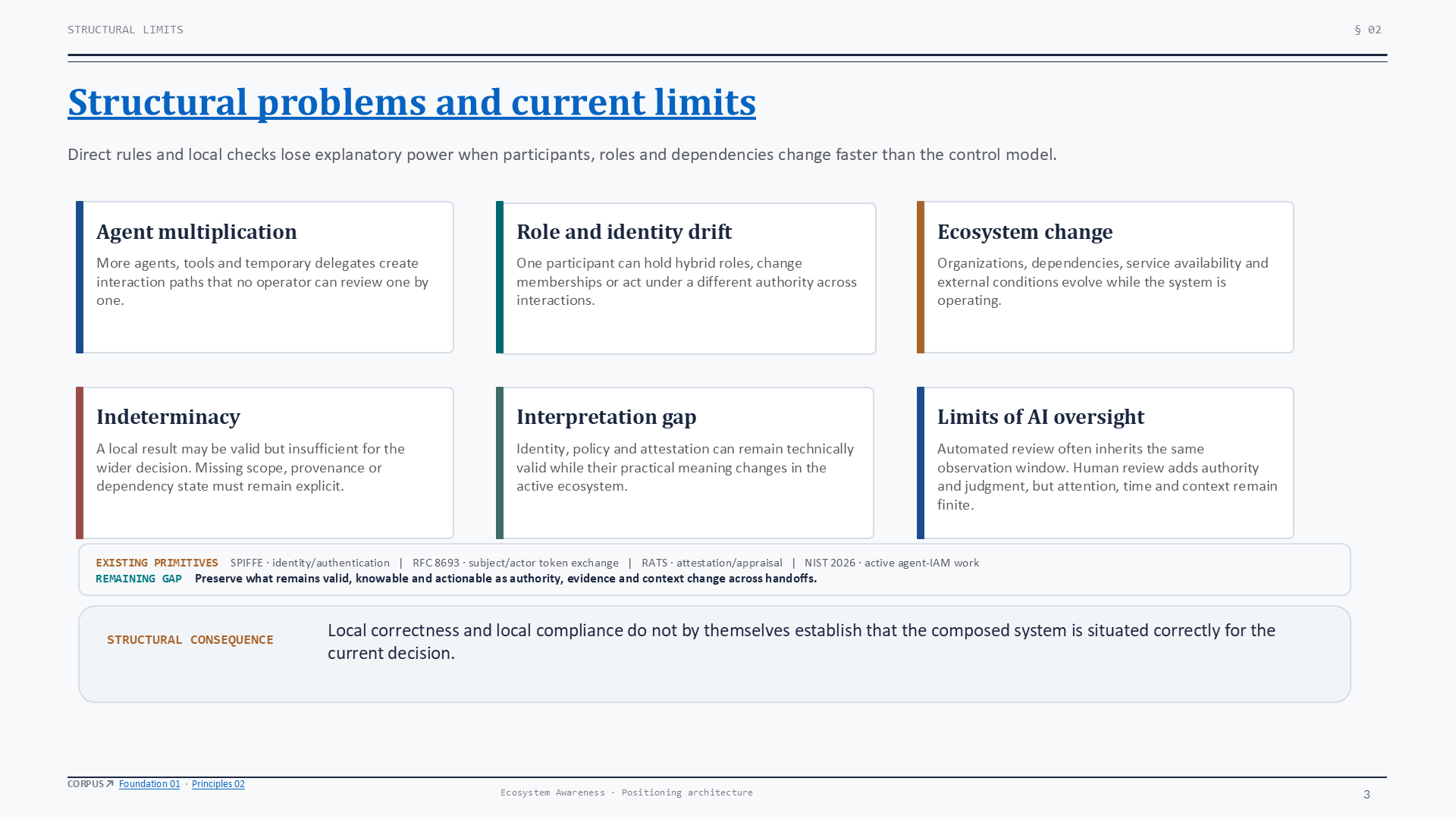
Tegrity.AI
When the Controls Work but the System Fails
Understand how a system can fail through the relationships between locally correct controls.
Read articleJubAp.us
Surviving Capability: Why the Field Celebrates What the Theory Condemns
Understand how capability developed under constraints can outlive the conditions that first produced it.
Read article