TEGRITY.AI / THE INTEGRAL MANAGEMENT SOCIETY 01 THE FINDING
Summary · When the controls work
but the system fails
This summary is based on the public-facing article written by Iván Abril Palma, which explains the foundations and gives a full account of the work. Full article: a public-facing explanation of the foundations
Institutional context. The ITU-T Focus Group on Trust and Identity for Humans and Agentic AI (FG-TIDA) was announced by the International Telecommunication Union at the AI for Good Global Summit on 9 July 2026 and reports to ITU-T Study Group 17. The Integral Management Society contributes to this open pre-standardization work. Ecosystem Awareness is our association’s independently developed contribution to that wider field; publication here does not imply endorsement by ITU, AI for Good or FG-TIDA.
FG-TIDA · TRUST AND IDENTITY FOR HUMANS AND AGENTIC AI Our association, The Integral Management Society, is contributing six anti-goals as a model to the open work of FG-TIDA, an ITU-T focus group: what must a system preserve to avoid global failures even when its local controls keep working? |
|---|
Six anti-goals we want to avoid
1 The 100-Million-Token Company A multinational automates its work with AI: it consumes 100 million tokens and creates an enormous burden of human supervision. In the end, no substantive work is completed and no useful new information is produced. | Seemingly small changes produce the unthinkable: some vehicles travel normally, others follow incompatible emergency routes, and others wait for human intervention that never comes. |
|---|---|
3 The Cyber Napoleon Marching on Russia Robots are cleaning a bar. One, misconfigured, believes it is Napoleon and persuades the others: they end up marching in formation towards Russia, with forks for rifles. | A hacked helpdesk computer (or even one that has not been hacked, due to cumulative changes), with no payment access or permissions, exploits a legitimate refund to trigger thousands of unauthorised refunds. The finding concerning the other 3,999 customers can also be lost. |
5 The Patch That Undid the Fix The pattern can affect the whole database: authorised repairs remain queued and run after other repairs have already fixed the problem. The obsolete actions undo the fixes and may interrupt the service. | 6 The Author Who Pays for Their Own Work An author registers and publishes their work. Third-party AI systems process and summarise it. The chain of rights ends up forcing the author to pay to use content derived from their own work. |
TECHNOLOGIES EXAMINED · documentary profiles by scenario | |
1 Microsoft Agent 365 · LangGraph / LangSmith | 2 FIWARE NGSI-LD / Orion-LD · AWS IoT Core / TwinMaker |
3 OpenAI Agents SDK / Agents API / Responses | 4 Claude Agent SDK · Stripe Radar / Refund API |
5 AWS Step Functions / RDS and associated services | 6 Panodyssey · ODRL / JSON-LD · TEMS |
Is current technology ready to prevent these anti-goals? Three walkthroughs
1 Standard configuration | We assess how a standard installation would respond to the scenario we prepared. Failure can occur even when its controls work. |
|---|---|
2 Expert reinforcement | We repeat the scenario with reinforcements from a top-level engineer who already knows the failure mode. These may prevent or reduce the failure. |
3 A subsequent change | Keeping the same reinforcements, we introduce a change the expert might overlook or that might occur in their absence. The failure can recur. |
How we did it: using the documentation for nine technology profiles, we checked step by step whether their controls would prevent the failure. We ran test programs for specific cases, without testing all nine products in full or conducting mass deployments.
CENTRAL FINDING · THE TECHNOLOGY IS NOT READY · FURTHER WORK IS NEEDED In the walkthroughs examined, current controls do not maintain all the conditions needed to prevent these anti-goals when the environment changes. Gaps appear especially in walkthroughs 1 and 3; walkthrough 2 may prevent or reduce the failure. These exercises were conducted by our association. FG-TIDA has not validated them and they do not represent its position. |
|---|
TEGRITY.AI / THE INTEGRAL MANAGEMENT SOCIETY 02 FOUNDATIONS AND SOLUTION SPECIFICATIONS
Specifications that prevent the failure modes above
OUR HYPOTHESIS · WHY THE ANTI-GOALS ARE NOT BEING PREVENTED Roles, dependencies and rules in the ecosystem change faster than a participant recognises. A locally valid decision can lose its basis. Our theoretical foundation is limited representation and regime change: distinguishing what is known, what can be determined and what lies beyond reach separates legitimate uncertainty, paralysis and false certainty. |
|---|
What distinguishes this approach: Ecosystem Awareness
From this hypothesis, we formulate specifications collectively called Ecosystem Awareness. We identify a difference from current industry standards in the combination of:
Knowing what is known — epistemic state Distinguishing what is established, what remains to be checked and what lies beyond reach. | No offsetting gaps — non-fungible composition High confidence in one domain cannot erase what remains unknown in another. |
|---|---|
Reviewing in time — requalification Deciding what to recheck according to risk, available resources and time. | Preserving meaning — handoff Sharing scope, uncertainty and dependencies without imposing the same internal reasoning or a central controller. |
SPIFFE/SPIRE covers identity; OAuth RFC 8693, delegation; RATS, state verification; A2A/MCP, communication. None of the standards reviewed specifies how to preserve the unknown and the residual across systems, prevent confidence in one domain from offsetting gaps in another, and requalify the decision according to risk and capacity. This gap in the standards is what distinguishes Ecosystem Awareness.
From foundations to a verifiable outcome
6 PRINCIPLES · 14 REQUIREMENTS · 4 SUFFICIENCY CONDITIONS · 6 PREDICTIONS The predictions are concrete outcomes against which to test the proposal. Key performance indicators (KPIs) and pass criteria set thresholds, deadlines and observable effects. |
|---|
Theory and work on delegated authority support a common foundation, without tailoring requirements to each case.
RESULT · THE SPECIFICATIONS PREVENT ALL SIX FAILURES ON THE DOCUMENTED PATHS We apply the specifications to the six scenarios above: each has a compliant path that prevents the failure. The documented walkthroughs, their executable subsets and the principle tests allow the result and its limits to be examined. |
|---|
Example: the smart city passes the walkthrough

PASS: visible conflict, authorised response and unresolved issues preserved.
What the tests support and what remains open
All 379 symbolic tests pass. The minimality of the six principles underpinning the requirements is proven in the model examined: removing any one reopens a failure unless its function is restored. Extensibility reaches broader families, in other sectors and at other scales, with the same failure mechanism. General sufficiency and external replication remain open.
Distinctive features: Tegrity.ai homepage · Comparison and tests: GitHub; Q path: PowerPoint I, slide 8
TEGRITY.AI / THE INTEGRAL MANAGEMENT SOCIETY 03 ARCHITECTURE
From specifications to an implementation model
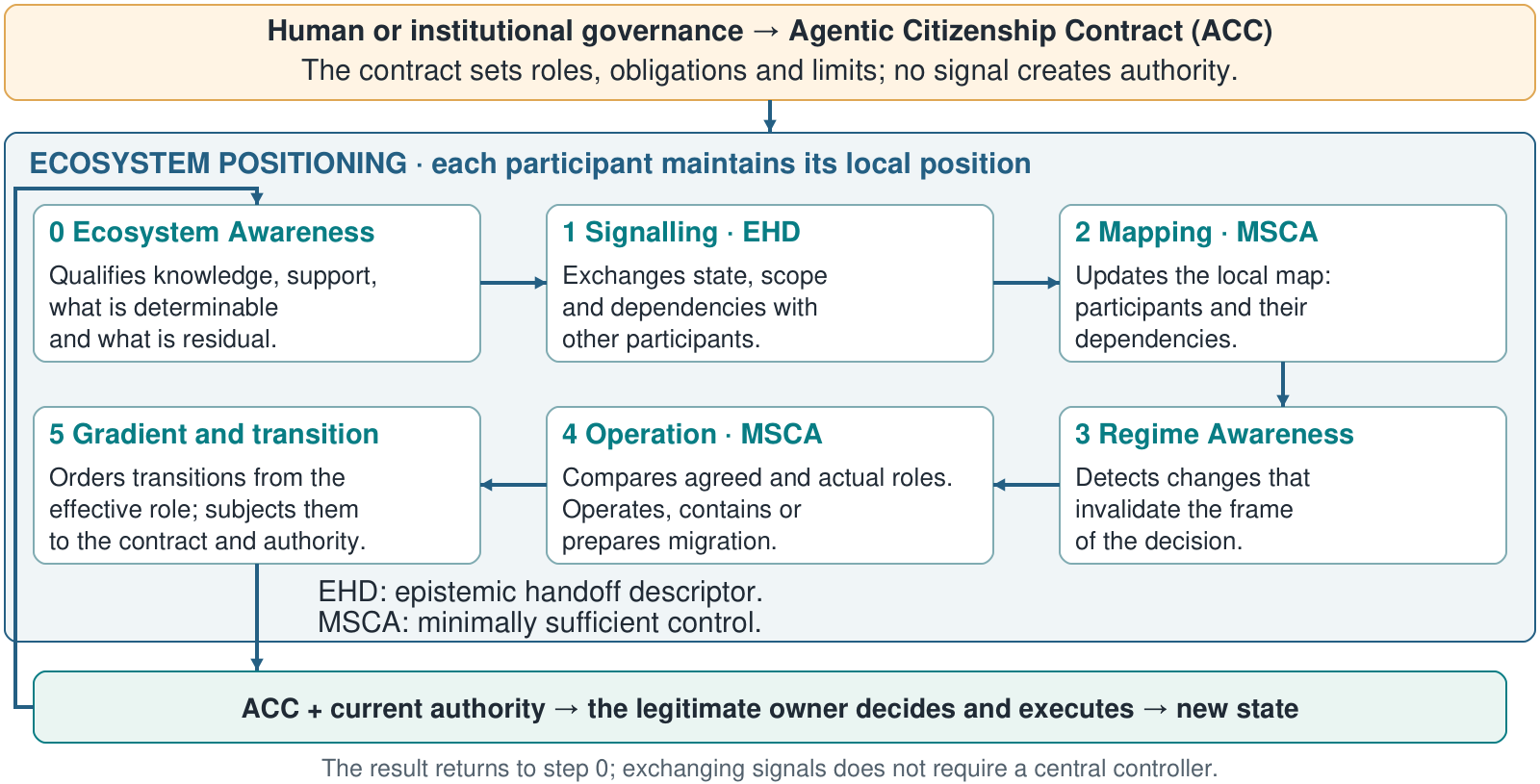
Ecosystem Positioning is a technology-independent implementation model for the specifications above, implementable through current or future solutions. The terms are deliberately new and generic, as requested in the FG-TIDA work: a proposal to rethink the foundations, not a specific platform.
AGENTIC CITIZENSHIP CONTRACT · ACC Human or institutional governance establishes membership, roles, objectives, obligations, prohibitions, autonomy and revocation. This contract bounds the cycle from the outset and must be respected when authorising each transition. |
|---|
A living epistemic position for every decision
A What is represented What the agent asserts and from which frame. | B Its firmness What support the assertion has. | C What is determinable What it can establish with the available capacity. | D The residual What lies beyond what is represented and reachable. |
|---|
A/B/C/D are maintained for the decision window. B does not eliminate C or D. Capacity includes actual human availability.
Architecture and cycle under the Agentic Citizenship Contract
Leadership, development and available components
Ecosystem Awareness is led by members of our association, The Integral Management Society, and is developed primarily within FG-TIDA, though not exclusively. FG-TIDA also has many other distinct and equally interesting workstreams. General interfaces, validation profiles, frozen cases with expected responses (fixtures), programs that run and check them (harnesses), traces and records are available. The FG-TIDA package connects these components to requirements and interfaces between contributions; it distinguishes what is supported, what is a candidate and what is not established.
Canonical README · Ecosystem Positioning · FG-TIDA GitHub
Sources and components on GitHub · Cycle adapted from Architecture & Implementation, slides 3–5
Document Status — Public-facing Summary · Series: Ecosystem Awareness
This page is a condensed guide to the public-facing foundation article and its technical annexes. It introduces no independent evidentiary claim and is not the canonical technical source. Publication on Tegrity.AI does not imply peer review, independent validation, production readiness, adoption as a standard or endorsement by the ITU, FG-TIDA or any cited organisation.
References and an invitation to the reader
Direct links: Ecosystem Awareness · FG-TIDA GitHub · Theme #13 · @dakleyer
Presentations in the README: Requirements & Evidence and Architecture & Implementation. The article, presentations and annexes communicate the corpus; GitHub is the canonical technical source.
What we need and what you can contribute
Choose one or more contribution tracks. When you contact us, indicate the track, the concrete contribution you propose, your availability, and whether the contribution is voluntary work, in-kind support or financial support. Tracks are flexible, non-exclusive and may be combined or changed over time.
| Track | Contribution area | What you can do | Expected output or support mode |
|---|---|---|---|
| A | Independent Research, Evaluation & Challenge | Evaluate whether a claim, method or proposed control is actually supported by evidence. Independently reproduce or challenge results; design tests, metrics and benchmarks; compare strong baselines; perform adversarial or formal review; assess evidence quality and limits. This track primarily evaluates evidence and claims rather than implementing production systems. | Replication note, benchmark/test protocol, adversarial review, formal model, comparative evaluation, evidence annex or methodological recommendation. |
| B | Engineering, Implementation & Deployment Validation | Build, integrate, instrument, deploy or technically modify systems and controls, then validate how they behave in realistic environments. Implement architectures, interfaces and tooling; run pilots; test interoperability and deployment behaviour. This track primarily produces and validates working technical implementations rather than independently assessing research claims. | Code, fixture, reference implementation, deployment/test report, interoperability result, technical architecture, implementation finding or validated engineering requirement. |
| C | Enterprise Governance, Information & Stakeholder Readiness | Provide or review governance cases; develop and test frameworks for decision rights, accountability, information readiness, data ownership and stakeholder governance; map enterprise constraints, control gaps and organisational dependencies. | Governance case, governance framework or matrix, RACI/decision-rights map, information-readiness assessment, stakeholder map, control model, policy/requirement proposal or enterprise operating-model analysis. |
| D | Strategy, Business Value & Competitive Advantage | Assess where AI creates genuine process, organisational or market advantage; analyse economics and trade-offs; contribute strategy cases and frameworks; test adoption priorities, capability differentiation and second- or third-order business effects. | Strategic case, value model, ROI/TCO analysis, capability map, market/competitive analysis, investment criteria, adoption framework or business decision brief. |
| E | Operational & Implementation Field Evidence | Provide real implementation and production evidence: operational constraints, incidents, failure modes, workarounds, dependencies, drift, escalation problems, production signals and practitioner observations that show what actually happened in the field. | Anonymised implementation case, incident/failure record, operational evidence annex, workflow/dependency map, production observation, lessons-learned record or negative reference case. |
| F | Human, Social & Interdisciplinary Perspectives | Analyse human judgement, oversight, authority, trust, comprehension, behaviour, incentives, responsibility and social or organisational effects; contribute interdisciplinary frameworks, critiques and cases. | Conceptual analysis, human-factors protocol, behavioural or ethical review, legal/policy issue note, interdisciplinary case analysis, evaluation criteria or framework proposal. |
| G | Standards, Institutional & Programme Coordination | Map relevant standards and institutional routes; prepare or review contribution packages; coordinate external exchanges, working groups, workshops and review cycles; structure work packages, dependencies and follow-up. | Standards mapping, contribution/submission package, liaison or institutional brief, work plan, workshop/review record, minutes/action register or documented institutional pathway. |
| H | Knowledge, Publication & Communication | Turn validated work into clear, traceable and reusable knowledge assets; improve documentation and repository structure; edit or translate material; create visual explanations; support publication, teaching and dissemination without inflating claims. | Release-ready document, repository package, article, presentation, diagram, glossary, translation, teaching material, publication asset or event/session content. |
| I | Resources, Infrastructure & Support | Provide compute, testbeds, tools, licences, datasets, professional services, venues, logistics, field support, in-kind resources or financial support for agreed AIRG work. | Defined infrastructure or resource package, dataset/tool access, specialist service contribution, event/logistics support, scoped sponsorship or patronage record. Resource or financial support does not determine technical conclusions. |
| J | Open & Emerging Contributions | Propose a clearly scoped new contribution, cross-domain connection, emerging discipline, experimental line of work or candidate new track that does not fit the existing structure. Ideas are not confined to this track; they are welcome across all tracks. | Short scoped proposal explaining the problem, relevance, expertise offered, intended contribution, expected evidence or deliverable and proposed next step. |
How to select your route: quote one or more tracks, describe what you will contribute and how, and state whether the contribution is voluntary work, in-kind support or financial support. The detailed participation framework and recognition rules are set out in the AIRG invitation, Addendum A and Annex B.
Start with an idea, a case or a test. Contact directly
You can also participate in FG-TIDA with a free ITU account and follow contributions by @dakleyer.
Two distinct forms of financial support
Every contribution is quantified and recorded against a defined scope. Neither route buys technical influence or changes the evidence.
Agentic AI Patronage · whole roadmap
A patron makes a defined financial commitment to the complete Ecosystem Awareness and agentic-systems roadmap for an agreed period. The contribution sustains shared research, verification, coordination, publication and technical infrastructure across work packages rather than being allocated to one deliverable.
Sponsorship · project or activity
A sponsor funds a named project, work package, test campaign, independent review, publication, event or other specific activity. The amount, scope, period, intended use and form of recognition are recorded for that sponsorship.
What patrons and sponsors make possible
Supporters can demonstrate, through a precise public record, that they helped finance pioneering, open pre-standardization work on trust, identity, ecosystem awareness and the emerging agentic Internet. They receive recognition matched to the exact contribution, visibility into progress, and invitations to relevant briefings, demonstrations or review sessions. Where there is technical fit, they may also propose cases, questions or evidence through the Industry Reference Group. Financial support does not confer certification, control the conclusions or imply endorsement by ITU, AI for Good or FG-TIDA.