
The Whole Program
The whole program in one read — every idea explained, every series and paper linked, so this page works as both a synthesis and an index you can navigate from.
Document Status — Synthesis & Reader’s Index · the map to the whole corpus
Tegrity.AI · The Integral Management Society
This is the deep version of the front door. It explains the one idea and each discipline, restores the independence test and the falsifiable battery, and ends with a full link map. The throughline under everything is structural awareness — diagnosed, recovered, and detected across human transformation and adaptive systems alike. Browse the whole body of work at the Field Notes hub.
The one idea, explained
There are two real things, and only two. The flow — what is actually happening in the work: who really does what, what really depends on what, where value really comes from. And the map — the recorded representation of that flow: the records, architecture models, org charts, lists of what matters and who owns it. There is no third, ideal version; just the work and the picture of it.
Decisions are made on the map, because no one can take in the whole flow at once. The map is therefore not a passive description — it is a control surface, the thing decisions are applied through. And the map is never quite the flow; it drifts. The consequence that makes the whole program: acting on a drifted map does not merely misunderstand the flow — it reaches in and deforms it. That is back-action, in two forms:
- Representing changes the thing. Measuring or declaring alters behaviour. Ask “who owns this?” and people reposition; the answer is partly produced by the asking.
- Acting on the representation changes the thing. Decide on the drifted map — cut this, fund that — and the real flow is reshaped by a decision computed on a picture that had already diverged.
Two distinctions carry the rest. Declared vs found information: declared is what the organization says about itself (importance lists, ownership, ratings) — cheap to assert, easy to game; found is what the estate reveals (logs, lineage, dependency traces) — less exposed to strategic assertion, but still partial and instrument-dependent. And three words, kept apart: structural awareness is the faculty of seeing the real structure; the gap is the divergence between map and flow; friction is the production loss from acting through a divergent map. One capacity, one state, one cost.
In one sentence: organizations decide on a map that has drifted from the work, and acting on the drifted map damages the work — destroying, surprisingly often, not the weakest parts but some of the strongest.
The phenomenon — real, and not invented
Before any theory there is a phenomenon. It is not the trivial “a map is never the territory” (true of every map, explains nothing). It is the specific, recurring failure anyone who has run large-scale change has met: modernization, transformation and automation programs fail or stall because the information was not ready — the organization did not actually know its own structure well enough to change it safely. It is the most basic failure mode across process mining, enterprise architecture, data management and mobilization, and automation including AI. The task was to explain it causally, then forecast what it implies next.
Structural awareness — the throughline, and the production feature
This is the spine, and the part that makes the program more than theory. Structural awareness is the faculty of seeing the real structure of a system — its true dependencies, contributions, and load-bearing parts — well enough to act without destroying it. The four series explain why that faculty is systematically lost. But the same idea is already a working feature, in three operational roles:
- a. Diagnostics — why and where it is missing. The enterprise-architecture work, formalized in the JUBAP framework (note below): finding where the map has drifted from the flow — the discovery gap, the attribution gap, the shadow set that turns out to hold critical capability.
- b. Finding it — how to recover structure across both human transformation and systems: tracing lineage and dependency in the estate, and recovering value and ownership in the organization, so a transformation knows what it touches before it touches it. This is the rule revalue before you clarify made into method.
- c. Detection — when the regime is changing. The Regime Awareness work (note below): detecting when an adaptive system is losing structural stability before failure is visible at the surface.
So the corpus is one faculty seen three ways: the theory explains why structural awareness decays; the diagnostics find where it is missing; the detection watches for the moment a system starts losing it.
The diagnostic-and-intervention side of structural awareness is a working practice. JUBAP (Jump Up Business Action Plan), the change-management and transformation framework of The Integral Management Society, is built for the hard case: mature, methodology-rich organizations (already running Lean, Six Sigma, Kotter, ISO) that still cannot turn strategy into coordinated action. It does not add another methodology; it finds the few high-leverage “button points” where a small, well-placed intervention unlocks the system, and treats resistance as concrete, locatable, and solvable. How they match: the four series explain why the real structure is hidden; JUBAP is how you intervene in the human organization without destroying it — the same “find the load-bearing points, revalue before you clarify” discipline, applied. Not covered in depth here — see jubap.net.
The gradual drift this program describes has an operational sibling: detecting when an adaptive system is losing structural stability before the failure shows. That is the Structural / Regime Awareness work — structural awareness turned into a running detector: a deliberately minimal, invariant-based monitor built around a strict safety ideal (pointwise non-inferiority — an intervention should never be worse than doing nothing). See Minimalistic Regime-Aware Early Warning Systems for the detector itself, and Regime Awareness Capability: Field Case for the systems already built on it. This is where forecast 11 (the closed-system terminal crossing) meets a real instrument.
The four disciplines, explained
Cost of Clarity — information theory
Why doesn’t the map just get fixed?
Entanglement makes clarity cost rise faster than the system, and producing it carries real risk — no self-interested agent required.
Attribution Gap — economics
Why does the map drift damagingly?
Making a dependency explicit hands its rent away, so credit is kept away from the true source — decay by incentive, not neglect.
Human Intelligence Debt — organizational theory
Why doesn’t someone step in?
The capacity to see clearly and decide is structurally scarce, and scarcer as the system grows — AI, so far, tends to widen this gap.
Informational Friction — systems theory
Same object, with the human agent removed
Any controller acting on a wrong estimate drives the real state further wrong — holds for a thermostat as much as an organization.
The Cost of Clarity — information theory
Why doesn’t the map just get fixed? Three things, each to be understood, not just named:
- Entanglement. In a small system you can hold the whole thing in your head. As it grows, the parts do not merely add — they interconnect: each new application, rule, team, or dependency forms relationships with everything already there, so the number of connections grows faster than the number of parts. Knowing “how your work really runs” means tracing that web, and the web grows super-linearly. That density of cross-dependency is entanglement.
- The cost of clarity. Resolving the true state — discovery, lineage tracing, reconciliation — consumes real time and money, and because of entanglement that cost rises faster than the system itself. Clarity gets more expensive exactly when it is most needed.
- The risk of clarity (the part usually missed). Producing clarity carries downside, not just cost: (1) the observer effect — asking “who owns this?” changes behaviour and can change the answer; (2) decide-before-discover — you often must commit to a target architecture before you can fully discover the current one, so declaring a clean target is a blind bet; (3) you can destroy value you cannot yet see — clarity that resolves ownership before recovering value cuts the unowned load-bearing thing. So “just clean it up” is a decision under uncertainty, not housekeeping.
New: pricing clarity as a cost-and-risk that scales with entanglement, and the decide-before-you-discover bottleneck. Neighbours to credit: Shannon information theory and Kolmogorov complexity, the observer effect, value-of-information theory. Start with When the Problem Isn’t the Technology; the tests are in How to Measure the Cost of Not Knowing and Is Clarity Getting More Expensive?
The Attribution Gap — economics
Why does the map drift in a damaging direction? The mechanism is a rent: the moment you make a dependency explicit (“ninety-nine percent of what I deliver rests on system D”), you create a legitimate claim for recognition, budget, and authority at the source — threatening the credit you currently capture. So everyone is paid to keep dependencies implicit. Two distinct things follow, in causal order:
- Attribution distortion (the economic driver): the wedge between what a thing contributes and the credit it gets — a capture surplus on interfaces matched by a contribution deficit on the real source.
- Accountability entropy (the downstream result): once recognition has withdrawn, no one will own it. Many claim responsibility (it justifies their budget); none accept accountability (that means owning its blame).
The deficit widens on both sides of the cycle: in bad times, a control-grab (when the input fails, everyone fights for oversight of the source without owning it); in good times, a contest of heroes (success is claimed by many; the real contributor is one claimant among many). At the cut, even with facts on the table, the decision turns on will: the room affirms the capability matters, is asked who will own it, and the answer is silence. The unowned high-contributor is cut — disguised as “retiring legacy” or “not deploying the new” — with its value still in it. Two more faces: the build-vs-buy inversion (firms buy what they could build, because the internal ledger understates value and overloads cost) and growth masks hollowing (acquiring outside value hides internal extraction, until the external-supply treadmill can’t keep up).
New: the specific chain — incomplete contribution-visibility → attribution distortion → ownership/funding withdrawal → destruction — as decay by incentive, not by neglect. Neighbours to credit: hold-up and property-rights theory (Hart, Moore, Grossman; Williamson), here inverted; Coase’s transaction-cost theory as a “dark complement”; the resource-based and dynamic-capabilities view (Penrose, Teece, Jacobides, Baldwin, Felin & Foss); strategic-opacity economics (Hirshleifer, Grossman–Stiglitz, Gorton & Holmström); zombie lending (Caballero, Hoshi & Kashyap). Start with The Attribution Gap and Capability Loss; the protocol is the Attribution Gap Measurement Protocol; the cross-series bridge is here.
Human Intelligence Debt — organizational theory
Why doesn’t someone with authority step in? The person who could — who can stand back, see the real structure, and make the hard call — is genuinely scarce, and the few who can are buried and out of time. The bottleneck is neither technology nor money; it is the capacity to see clearly and decide, scarce by structure and scarcer as the system grows. The series makes it measurable: the Optimal Human Intelligence Ratio (the ceiling), Human Intelligence Density (the floor), and Operational Intelligence Debt (the gap — cognition absorbed by work technology could already handle). Its sharp claim: AI, so far, tends to widen the gap by adding layers of governance, validation, and review.
New: quantifying the wasted-cognition gap and the AI-widens-it prediction. Neighbours to credit: the productivity-paradox literature, automation-vs-augmentation, bounded rationality (Simon). Start with Measuring Human Intelligence Debt and its Evidence Notes.
Informational Friction — systems theory
The same object with the human removed, so it holds for any system that runs on a picture of itself:
- Frame-bounded optimizer vs cross-frame coherent agent. The first maximizes what is visible inside its declared frame (in an organization, its own attribution); the second preserves an independently established upstream outcome even when local rules conflict. The first is common; the second is the scarce, currently-human thing.
- The fully map-specified agent. An agent whose objectives, observations, and feedback are fully specified through the declared map is bound by it and cannot preserve structure absent from it — safe on healthy systems, destructive on divergent ones, with the danger rising with divergence.
- Insolvency = failure by compliance. The point where no path satisfying all mandatory constraints preserves the upstream outcome; the rules, followed faithfully, produce nothing or harm, and only deviation keeps the thing alive.
- Deviance-dependence & the conformance counterfactual. The share of output that flows off the map; tested by reconstructing the as-designed path and seeing what it yields (zero or harm at a wide gap). Process mining is the discovery layer; outcome and counterfactual evidence complete it.
- The maturity inversion = control-density without integration. More mature, audited, certified systems become more dependent on positive deviation — because each control body adds a constraint, the conjunction becomes impossible by compliance, and output survives only by deviating. Integration is the moderator.
- Selection is nested, not a rival. External selection registers boundary outcomes but not the internal map–flow divergence; internal selection runs on declared proxies and can mismeasure the cause. Neither reaches into the gap.
- Capabilities do not communicate themselves. The off-map truth doesn’t travel upward, so clarity arrives blind.
Neighbours to credit: cybernetics and requisite variety (Ashby), closed-loop state estimation (Kalman), the Goodhart and Campbell laws, conformance checking, the positive-deviance literature, performativity (MacKenzie). The papers: The Map and the Flow (the object), Optimization, Coherence, and the Frame (the agent), Why Selection Cannot See It (the dynamics and the tests), and The Outlook (the forecasts).
Why four — the independence of the primitives
The four are not four independent confirmations; counting them as four proofs would be a mistake. What is claimed is narrower: they share one phenomenon but were built from genuinely different disciplinary premises chosen to explain it, and the common conclusion was not assumed in advance — it was worked out independently in each series and only recognized afterward (ex-post) to coincide. That makes the agreement abductive support: real, but not proof of existence. The real evidence is the tests. The strength depends on whether the starting points are really independent — state each primitive and test:
| Series (discipline) | Its primitive — the bare starting assumption | Self-interested agent? |
|---|---|---|
| The Cost of Clarity (information theory) | Resolving which state a system is in consumes resources; the proposed drivers are dependency entanglement and unresolved declarative state, not complexity in general. | No |
| The Attribution Gap (economics) | Agents allocate on credit; credit can be privately asserted; so credit can diverge from contribution. | Yes |
| Human Intelligence Debt (organizational theory) | The faculty to integrate and decide across a whole system is structurally scarce and concentrates as it grows. | No |
| Informational Friction (systems theory) | A controller acts on an estimate of a system’s state; acting on a wrong estimate drives the real state, so error feeds back. | No (no agent at all) |
Pairwise test — can either member be derived from, or does it presuppose, the other?
- Incentive × Feedback — strongly independent, the best pair. One requires a self-interested agent; the other requires no agent at all (a thermostat has it). Nearly disjoint premises reaching the same place — the hardest convergence to dismiss as circular. Lead on this.
- Incentive × Scarcity — independent. What agents want vs how a faculty is distributed.
- Cost × Scarcity — independent. Price of information vs distribution of decision capacity.
- Cost × Incentive — independent. Rent survives free clarity; cost survives honest agents.
- Scarcity × Feedback — independent. Back-action with abundant deciders; a bottleneck with a perfect map.
- Cost × Feedback — the weak pair, conceded. Feedback presupposes the true state isn’t fully known — which is what cost is about. Not fully independent.
Verdict: five of six pairs are genuinely independent at the level of the driving mechanism; the convergence is real but moderate — strongest between economics and systems theory, weakest between information theory and systems feedback. One more honest caveat: all four derivations passed through a single investigator holding one phenomenon in view. So the convergence raises the prior modestly and justifies the tests; it does not replace them.
The falsifiable core — the tests
The program is built to be refutable on records firms already hold. Each test states what it measures and what result would break it. (Full statements live in the foundational Attribution Gap paper, Why Selection Cannot See It, and the forthcoming consolidated refutation paper.)
From the Attribution Gap (economics)
- Discovery gap / shadow enrichment — estimated vs discovered application count, and the shadow set over-represents high-contribution sources. Refuted if the undocumented set is just junk, controlling for age and scope.
- Ownership-silence — importance affirmed + no accepted owner materially raises the hazard of {non-investment, shadowing, elimination}. Refuted if silence doesn’t predict the outcome.
- Internalization wedge — acquisition value (capability share) > later internal attribution.
- Build-vs-buy inversion — rejected internal build, then external buy of a comparable capability.
- Rationalization scar — critical capabilities more fragmented and persistent; traceable to past failed cuts.
- Loss is informational, not performance-driven — a significant share of losses fall on still-productive capabilities via ownership/value indeterminacy.
From Informational Friction (systems theory)
- Conformance counterfactual — compliant execution yields zero/harm at a wide gap.
- Deviance-dependence — the off-map output fraction; trends toward one in legacy estates.
- Maturity inversion — control-density-without-integration predicts higher deviance-dependence; refuted if well-integrated mature systems show lower.
- Maximizer-lethality — automated clean-up destroys value at a rate rising with deviance-dependence.
- Loss clusters after carrier departure, not after a measured performance shock.
From the Cost of Clarity (information theory): the cost and risk of discovering how your work runs are directly measurable and rise with entanglement. From Human Intelligence Debt (organizational theory): the debt is measurable, and AI deployments are followed by more governance/validation work, widening it.
The decisive experiment (spans economics + systems): a controlled comparison of clarity-only vs revaluation-then-clarity on matched portfolios — prediction: clarity-only increases erroneous capability destruction; revaluation-then-clarity reduces it.
The anchor interaction (the Outlook’s core test): on matched processes, ΔWork = β1·Automation + β2·DevianceDependence + β3·(Automation × DevianceDependence), predicting β3 > 0 — a null or negative β3 refutes the anchor.
The exposed flank (stated honestly): measuring contribution independently of attribution — the central measurement problem the empirical ladder exists to clear.
The Outlook — the shocking ideas, and the test for each
Each forecast holds only while its test survives. The defensible register is gradual, lawful drift; collapse is the fenced terminal edge. Full development in The Outlook.
- Inefficiency before unemployment (anchor). Automation, on the tangled systems we run, raises inefficiency and total work before it cuts jobs. Test: β3 > 0.
- Lethal on the sick, safe on the healthy. Clean-up destroys most value where it’s sent to fix the worst mess. Test: maximizer-lethality.
- Coherence-capacity debt rises. The scarce human carriers of coherence are demanded faster than they appear. Test: coherence-radar + maturity.
- The maturity inversion. The most controlled systems are the most dependent on deviation. Test: maturity-inversion.
- Deviance-dependence trends toward one. Test: conformance-counterfactual + deviance-dependence.
- Discovery gaps widen — the undocumented set over-represents load-bearing structure. Test: discovery-gap.
- Build-vs-buy keeps inverting; growth keeps masking hollowing. Test: internalization-wedge + build-vs-buy.
- Clarity without revaluation accelerates the loss. Test: the decisive governance-treatment comparison.
- Carriers are squeezed as the system sickens — collapses cluster after carrier departures. Test: coherence-radar residual + loss-is-informational.
- (Conjecture) Economy scale: the most-revered non-tradable capabilities lose their carriers first, filled by imported labour. Fenced; trade named as the rival.
- (Conjecture) Closed systems reach a terminal crossing — fed no external structural awareness. Test: the F/−F regime-detection conjecture — where the Regime Awareness detector meets the theory.
The one rule, and what stands vs what is fenced
The rule, in all four series: before you cut anything, see the real structure, not just the map; bring the clarity from outside the part of the system that profits from the murk (external by mode, not necessarily by position); and above all, revalue before you clarify.
- Defensible spine: in partially observable systems run through a materially divergent map, decisions on the map deform the flow; undocumented compensating work becomes load-bearing; automation bound to the map removes it in proportion to prior deviance-dependence.
- Bounded, not proof: the four-way convergence (strongest on the disjoint incentive×feedback pair, weak on cost×feedback).
- Witnessed, not proven: Nokia motivates the instrument-complementarity claim; it does not establish it.
- Fenced as conjecture: terminal collapse, and the economy-scale generalization.
- Exposed flank: measuring contribution independently of attribution.
Full map of the corpus — the index
Everything in one place. Hub: Field Notes.
Core program — the four series
Under Human Intelligence Debt.
The Cost of Clarity — information theory
- When the Problem Isn’t the Technology (Paper 1)
- When Asking the Question Changes the Answer (Paper 2)
- When You Have to Decide Before You Can Discover (Paper 3)
- When Cleaning Up Means Betting Blind (Paper 4)
- How to Measure the Cost of Not Knowing
- Is Clarity Getting More Expensive?
- The Minimal Information a Transformation Needs
- What Goes Unpriced Is Paid in Human Intelligence (cross-series bridge)
The Attribution Gap — economics
- The Attribution Gap and Capability Loss (foundational paper)
- Attribution Gap Measurement Protocol
- Bridge: The Attribution Gap and Capability Loss
Human Intelligence Debt — organizational theory
Informational Friction — systems theory
- The Map and the Flow (Paper 1)
- Optimization, Coherence, and the Frame (Paper 2)
- Why Selection Cannot See It (Paper 3)
- The Outlook (companion)
The wider corpus
AI Integrity Management — AI governance discipline
- AI Integrity: a Critical Frontier (Paper 1)
- The Case for AI Integrity Management as a Formal Enterprise Function (Paper 2)
- One Function or Many? (Paper 3)
- The Semantic Tug-of-War (Paper 4)
AI Operational Integrity Architecture — AI systems architecture
- Toward Expert-System Envelopes Around Statistical AI (Paper 1)
- Structural Limits of Current AI Integrity Under Regime Change (Paper 2)
- From Complicated to Complex: The AI Safety Paradox (Paper 3)
Structural / Regime Awareness in Adaptive Systems — detection
- Minimalistic Regime-Aware Early Warning Systems (anchor)
- Regime Awareness Capability: Field Case (the systems built)
Cross-series bridges
- The Limits of AI Oversight (AI Operational Integrity Architecture × Human Intelligence Gap)
- What Cannot Be Recovered Must Be Managed (Human Intelligence Gap × AI Integrity Management)
The practice
- JUBAP — the change-management & transformation framework (diagnostics and intervention).
- The Integral Management Society — the institution.
- Tegrity.AI — the operational arm.
—
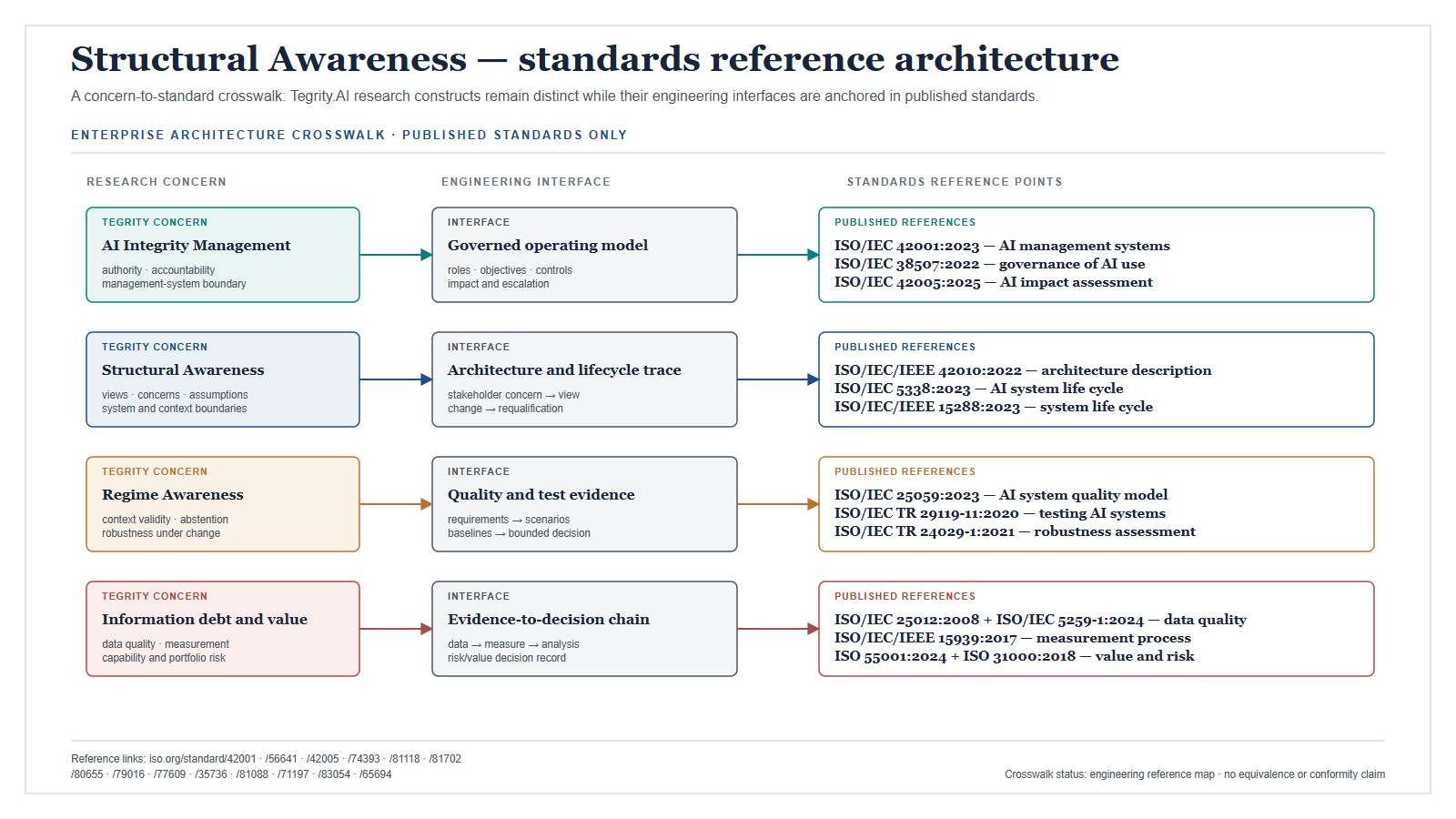
Conceptual neighbours and references
- ISO/IEC/IEEE 42010:2022 — provides the architecture-description foundation for relating concerns, viewpoints, models and the entity being represented.
- ISO/IEC 42001:2023 — provides the organisational management-system boundary into which Structural Awareness evidence can feed without becoming the management system itself.