
Why the information you need to fix a process can’t be found — only declared — and why declaring it changes the process
AI Integrity Management working group, The Integral Management Society
The first article in this series made a simple claim: large efforts to simplify, automate, or improve an organization usually fail for lack of information about how the work actually works — not for lack of technology. The obvious response is, then go and get the information. This article is about why you often can’t, and why the reason is stranger than mere difficulty.
There are two ways a fact about your organization can be missing. The first is ordinary: the fact exists — who set this up, what it was for — it is simply buried in an old document, a departed colleague’s memory, a system nobody opens. Effort recovers it. The second kind is different, and far more common than people expect: the fact was never decided in the first place. There is nothing to recover, because there is nothing there.
“Who is accountable for this system?” feels like a question with a hidden answer. Often it has none. If no one was ever made accountable, there is no true answer waiting to be found — and the only way to obtain one is to create it, by declaring that someone is now accountable. Philosophers draw this exact line between describing the world and acting on it: “the meeting is at three” describes; “I now declare the meeting open” acts and makes something so. A great deal of what an organization appears not to know about itself is really something it never decided.
The paradox
Here is where it turns, and it is the whole of this claim.
To study a process, you need this information. To get this information, you must declare it. And declaring it changes the process. So the act of studying the process changes the process. You cannot look without touching. The information you need before you can safely modify a process is information whose very retrieval is already a modification — and the same is true whether you are trying to simplify the process, document it, or hand it to an AI. The study that is supposed to come first is itself the first change.
The proofs
This is not wordplay. It is concrete and repeatable.
Cost
Money is moving, so the cost certainly exists. But “who owns this cost?” often has no answer. Declare an owner, and the people who had been quietly paying often stop — the budget has to be rebuilt. Measuring the cost changed it.
Accountability
You can watch who does the work; you usually cannot find who answers for it, if that was never assigned. Naming them puts responsibility on shoulders that did not carry it a moment ago.
Data
The sharpest case. The moment you must trust data rather than merely consume it, you have to declare which source is real — and choosing one source over another changes which data flows, along which path, under which rules.
In each case, the answer did not exist before the question, and the asking is what brought it into being — at the price of changing the thing asked about.
The clinching test
There is a clean way to tell whether a missing fact was the recoverable kind or the never-decided kind: ask several competent people, independently, to reconstruct it. If the fact was really there, they converge on the same answer. On the questions that matter most — who owns this, what is the true source, how does this actually work — they don’t. Ten capable analysts may produce ten coherent but materially different accounts. That divergence is the proof: there was no single buried truth to recover, only a field of choices. None of them found the order; each imposed one.
Not a metaphor, and not physics
It is tempting to call this an “observer effect” and reach for quantum physics. Resist it — this needs no physics and is not a metaphor. It is a plain, documented feature of organizations and of measurement itself. Social scientists have shown for the better part of a century that the act of measuring changes what is measured: from the famous factory studies where workers changed their behavior simply because they were being watched, to modern research on how published rankings reshape the very institutions they rank. The effect here holds for an ordinary, demonstrable reason — the thing being asked about did not exist until the asking forced someone to decide it.
What it means
This is why “just hand the process to the AI” is harder than it sounds. Before an AI can run a process, someone has to state what the process is — its owners, its data, its rules. For anything genuinely disordered, that statement does not exist and cannot be looked up; it has to be decided, and deciding it changes the process before the AI ever touches it. The AI does not inherit a neutral picture of how things work. It inherits whatever was declared — or, where nothing was declared, it inherits the vacuum and deepens it.
So the binding constraint is not effort, not better tools, and not smarter models. It is the human act of deciding how the work should be ordered — an act that cannot be automated, cannot be skipped, and cannot be performed without changing the very thing it describes. The first article showed that the information is missing. This one shows that, for much of it, the only way to supply it is to remake the process in the act of asking for it.
Sources
- Describing vs. doing (constative vs. performative) — J. L. Austin, How to Do Things with Words (1962).
- Measuring changes what is measured — the Hawthorne studies (Western Electric, 1920s–1930s); Espeland, W. & Sauder, M., “Rankings and Reactivity” (American Journal of Sociology, 2007); MacKenzie, D., An Engine, Not a Camera (2006); Hacking, I., on the “looping effects” of human classification.
- Responsible vs. accountable — the standard distinction in organizational governance (RACI).
- Canonical source, data ownership, and lineage — established data-governance practice (e.g., DAMA-DMBOK), in which these are assigned by decision, not discovered as facts.
Conceptual neighbours and references
- Nearby work. Espeland and Sauder analyse measurement reactivity; Campbell shows how indicators used for decisions can distort the processes they monitor.
- Useful connection. Both support the claim that eliciting and formalising organisational facts is an intervention, not neutral retrieval.
- Most distinctive contribution here. The article separates recoverable facts from institutional facts not yet created by an authorised decision, then treats elicitation as governance back-action: asking can change ownership, boundaries and behaviour while it measures them.
Engineering standards connection
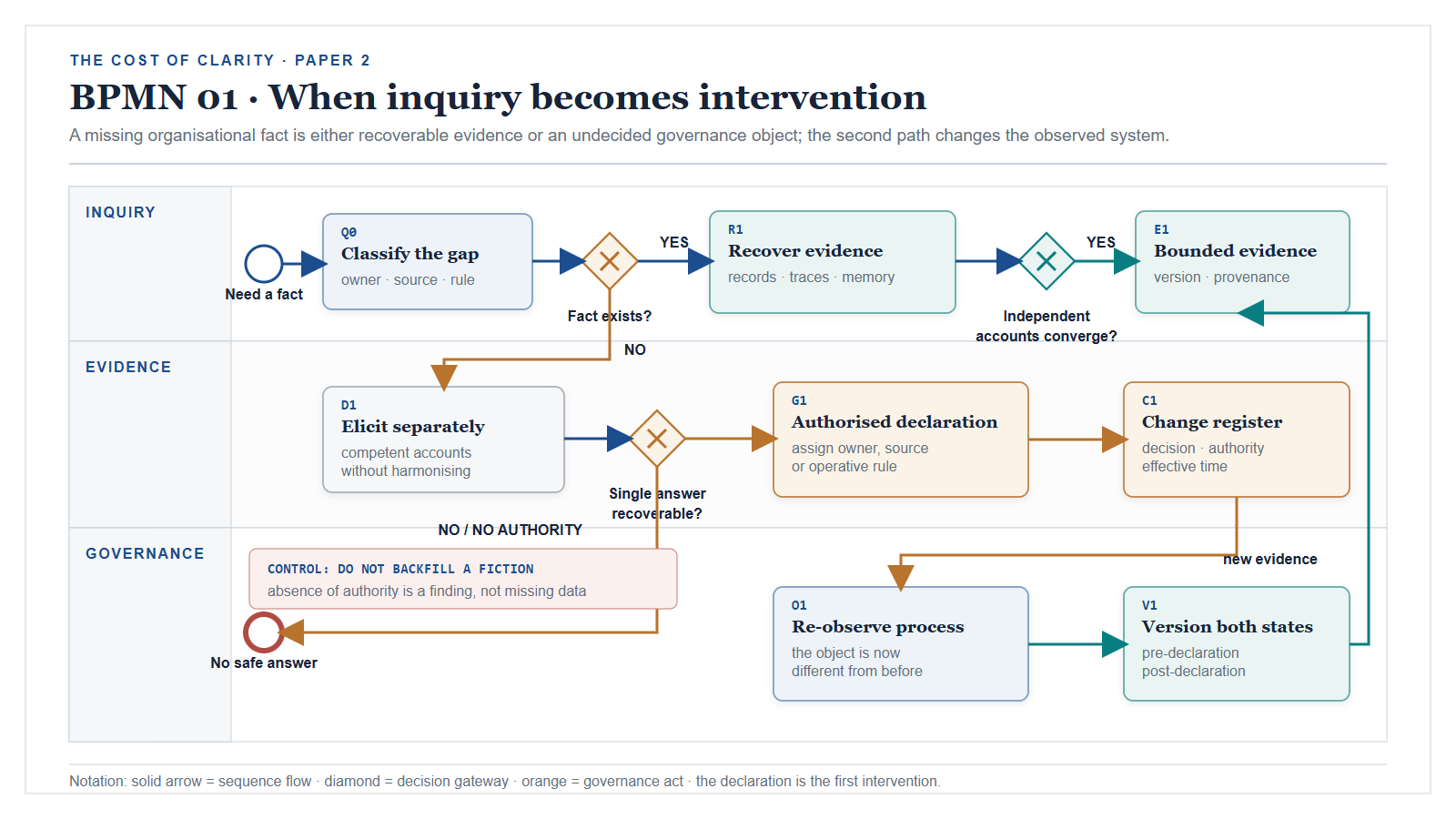
- ISO/IEC 19510:2013 — standardises BPMN process notation, used in the accompanying figure to distinguish recovery from an authorised declaration that changes state.
- ISO/IEC/IEEE 15288:2023 — provides the life-cycle process frame in which declaration-induced changes must be controlled, recorded and re-observed.