
Informational friction as a systems problem — why a representation that governs a flow it cannot fully observe tends to deform that flow, under conditions this paper makes explicit. Stated for systems in general, human or not.
Document Status — Foundational Working Paper · Paper 1 · Series: Informational Friction (a systems theory)
0. Scope and discipline
This paper states one object and the minimal claims that make it real. It does not argue the economics, the organization, or the future; those belong to the companion series and to the later papers here. What it must establish is that there is a single, concrete, systems-level object underneath all of them, and that the object can be defined without invoking human psychology, without a perfect ideal, and without borrowing from physics.
Claims are typed: [definition] (a stipulated meaning), [mechanism] (a causal pathway asserted for the class examined), [tendency] (holds under stated conditions, counter-cases admitted as tests), [conjecture] (offered for examination). One falsifiable anchor is stated at the end; the full battery of tests is gathered in a dedicated companion paper so that a critic can examine the whole program in one place.
1. The object: two real things, and no third
Strip the problem to two things. Both are real; neither is ideal.
The real flow is what is actually happening in the system: information transformed, dependencies that actually hold, work actually done. It is never fully observable from inside. But it is not a Platonic form that the system fails to reach; it is the territory, as concrete as anything — the events themselves.
The representation is the recorded model of that flow: the inventory, the dependency map, the ledger of who owns and who depends on whom, the diagram the decision is taken from. It too is concrete — it is artifacts.
[definition] The gap is the divergence between these two real objects: the flow, and a model of the flow. It is decisive that the gap is not between the real and a perfect version of itself. There is no third, ideal architecture the system is measured against and falls short of. There are only two real things — the territory, and a map of the territory — and the distance between them. We retire the word ideal entirely; it adds nothing and invites a metaphysics the argument does not need.
2. The control surface, and why the gap is not merely an error
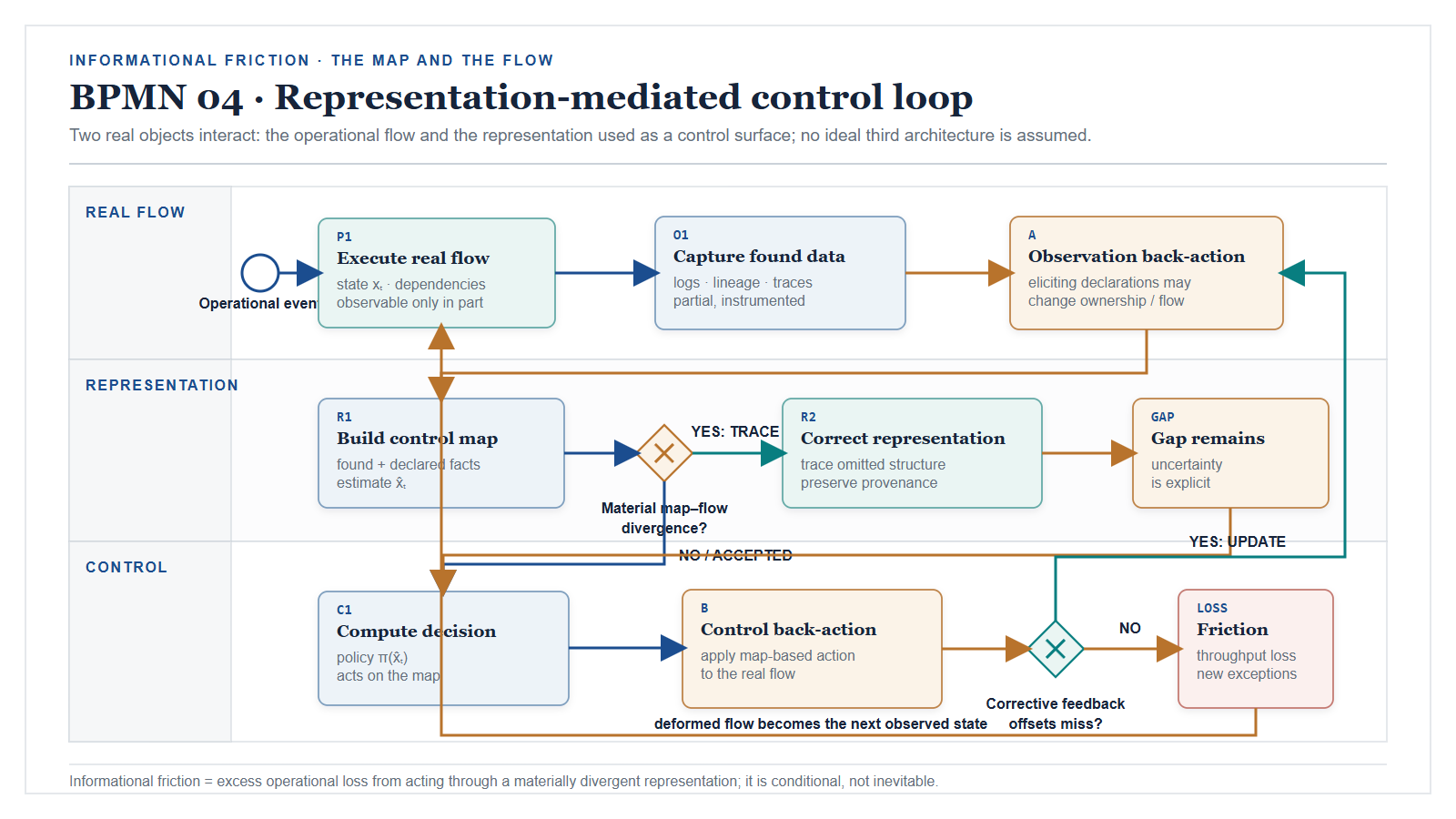
The load-bearing property is what the representation is for. It does not sit beside the flow as a passive description. It is the control surface: the surface on which decisions are computed and from which they are applied back to the flow. The map governs the territory.
[mechanism] This is why the gap is more than an error of knowledge. Acting on a wrong map does not only mislead the actor; it reaches into the territory and deforms it. The wider the gap, the more the executed action misses, and the miss is concrete — degraded throughput, a destroyed capability, work that exists only to compensate for the miss. A representation that governs a flow it misrepresents does damage in the flow, not only in the head of whoever holds the map. The error is upstream of the world, and it feeds back into the world.
[scope — the conditions under which this holds] The claim is a conditional tendency, not a necessity, and it is worth stating the boundary plainly so the theory does not over-reach. The deformation is expected only where five conditions are materially present: the flow is partially observable; control is representation-mediated (decisions run on the map, not on direct contact with the flow); there is material divergence between map and flow; corrective feedback is weak relative to that divergence; and the decisions are capable of modifying or removing operational structure. Where these do not hold — where the gap stays small, is corrected automatically, or the decisions cannot reach the structure — the loop need produce no significant harm. So the precise statement is: where a partially observable flow is governed through a materially divergent representation, actions computed on that representation tend to deform the flow unless corrective feedback offsets the divergence. Everything below should be read inside that conditional.
3. Friction, defined tightly
[definition] Informational friction is the production and coordination loss generated when actions computed on a divergent control surface are applied to the real flow.
Defined this tightly, it is not “coordination cost,” not “bounded rationality,” not “information is expensive,” under a new name. The claim is not the familiar one that maps are imperfect — everyone grants that. The claim is that the imperfection is upstream of the world and feeds back to enlarge itself: the control surface deforms the flow, the deformed flow is harder to represent, the representation diverges further, and the next action misses by more. Friction is the name for the loss this loop produces, measured in the flow. One observable is the additional exception-handling or rework time attributable to decisions made from a stale process map, compared with a matched workflow whose representation was updated before the decision.
4. Two back-actions, kept distinct
The representation acts on the flow in two different ways, and they must not be fused — they have different signatures and different remedies.
[mechanism] (a) Representing changes the thing. The act of producing the representation perturbs the flow. To record who owns a thing, the system must elicit a declaration, and the declaration alters what it describes. The measurement is not passive; the instrument touches the object.
[mechanism] (b) Acting on the representation changes the thing. Decisions computed on the map are applied to the territory; where the map and the territory disagree, the applied decision deforms the territory. This is the control-surface back-action of §2.
Both are real and both can widen the gap, but (a) is a disturbance of observation and (b) is a disturbance of control. A later paper turns each into a measurable; here it is enough to separate them.
5. The spine: declared versus found information
Two kinds of information about the flow, and the distinction organizes everything that follows.
[definition] Found information is read off the real estate: logs, lineage, dependency graphs, the architecture as it actually runs. It reflects the flow; it can be discovered by tracing; no one has to assert it. It is recovered from operational traces rather than from stakeholder declaration, so it is generally less exposed to strategic assertion — but it is not a neutral window onto reality: it remains partial, instrument-dependent, shaped by earlier modelling choices, and open to semantic error and logging failure. It is costly to gather, and harder to bend to one’s interest than a declaration, but it does not speak for itself.
[definition] Declared information must be asserted by an agent: who owns this, what is important, what the target is, what is critical. It cannot be found, only stated. It has three properties found information lacks: it costs to elicit, eliciting it perturbs the flow (back-action (a)), and it is corruptible — the declaration can diverge from the fact.
[mechanism] The representation that governs decisions is built largely from declared information; the real flow is legible only through found information; and so the gap is, at root, the divergence between what the estate reveals and what agents declare about it. This is the axis on which the whole program is measured: not the map against an ideal, but the declared map against the found flow.
6. Structural awareness — the missing faculty
State the deficit the way a system actually exhibits it. A system always has the pieces — the components, the records, the transactions, often in abundance. What it lacks is the structure: how the pieces compose into the flow, which of them is load-bearing, what truly depends on what. It holds a map — partial, local, declared — but never the map: the true architecture of the thing it is.
[definition] Structural awareness is the capacity to see the real structure of the flow — the true architecture, not merely its pieces or a partial map. It is a state of an observer relative to a system, not a document a system possesses. A system can be drowning in pieces of information and have almost none of it.
Three words, three roles, kept distinct so they do not collapse into synonyms. Structural awareness is the missing faculty; the gap is the divergence that remains when the faculty is absent; friction is the cost of acting without it. The remedy that recurs throughout the program — clarity from outside the system — is, in these terms, an injection of structural awareness; why it must come from outside is the subject of the companion papers.
7. Why this is systems theory: the human removed
The three companion series each tell this story inside a discipline that assumes humans: agents with incentives (economics), organizations with hierarchies (organizational theory), observers who pay to know (information theory). The contribution of this fourth series is to show that the object survives the removal of the human entirely.
[mechanism] Nothing in §§1–6 requires a person. It requires only: a flow that cannot be fully observed from inside; a representation of that flow used as a control surface; and an agent — of any kind — that acts on the representation because the representation is the signal available to it. Given those three, and the conditions set out earlier (material divergence and weak corrective feedback), the gap can open, the back-action can deform the flow, and friction can follow. A purely mechanical system that governs a process it cannot fully observe, acting on a declared model of it, has the same object natively. The three companion series are then instances of this systems-level object, each adding the texture of its own discipline; this series states the object beneath them.
This is not a flourish. It is what lets the program reach past organizations to any information-governing system, and it is what makes the later results about automated agents — in the companion papers — statable at all. Clarity, divergence, and back-action are properties of observers and control loops, not of human beings.
8. Self-amplification, without thermodynamics
[tendency] The loop tends to widen. A deformed flow can become harder to represent than the flow that preceded it — where the intervention introduces new states, exceptions or dependencies — so the next representation diverges further, and the gap grows, unless an outside force does work to close it. This is a tendency under stated conditions, not a law of nature, and not a thermodynamic claim.
The program uses the word “entropy” elsewhere in a strictly non-thermodynamic sense — the indeterminacy of who is accountable for what, the spread of possible true states of an answerability ledger. Any correspondence to physical entropy is, at most, an optional model held entirely apart from the argument; it is never an identity, and nothing here depends on it. We name this so that no reader mistakes a structural tendency for a borrowed law.
9. A formal home, offered not asserted
[conjecture] There is a concrete formalism that carries all of this without physics and without Platonism: closed-loop state estimation. The real flow is the true plant state; the representation is the observer’s estimate; decisions are control inputs computed from the estimate; and the plant evolves under those inputs in its true state, not the estimated one. Estimation error inside a closed loop degrades the plant — a standard, unremarkable result in control theory. “The true architecture we cannot fully arrive at” becomes “the true state the observer never fully recovers,” which is exact and carries no metaphysics. This is offered as a candidate home for the formalism, not as a result; the program does not depend on it.
[formal core, optional] A compact statement makes the testable quantity explicit. Let the true state of the flow at time t be xt, the representation (estimate) be x̂t, and the decision policy be π. Informational friction is the excess loss from acting on the estimate rather than on the truth:
IFt = L(xt, π(x̂t)) − L(xt, π(xt)),
and the back-action is that the plant evolves under the estimate-based input, xt+1 = F(xt, π(x̂t)). The central theoretical question is then precise and bounded: when does acting through x̂t increase the next divergence between xt+1 and x̂t+1 (a self-amplifying regime), and when does corrective feedback shrink it (a self-correcting regime)? The conditions of §2 are the informal statement of when the first regime obtains. This places the contribution next to closed-loop estimation and control, cybernetics, sociotechnical-systems theory, and the literatures on reflexivity and measurement performativity — neighbours, not premises.
10. A minimal falsifiable anchor
So that this paper is not pure definition, it commits to one testable claim; the companion papers add the rest and a dedicated paper gathers them.
[tendency — falsifiable] The discovery gap. In any sufficiently mature estate, a direct trace of the real flow (found information) recovers substantially more structure than the estate’s own declared model contains — more components, and, more pointedly, load-bearing ones that the declared model omits or marks as minor. The map systematically understates the territory, and it understates it most where the territory is most load-bearing. Falsified if a faithful trace of a mature estate recovers a structure that matches its declared model, or if the omitted structure is uniformly trivial rather than enriched for load-bearing nodes. (Confounds to control: component age and scope, and benign under-documentation; the claim is the non-random presence of load-bearing structure off the map, above what those benign reasons predict.)
That single anchor is enough to make the object empirical: if the declared map and the found flow did not diverge — and diverge in a way correlated with what is load-bearing — there would be no gap to govern on, and the rest of the program would not arise. The remaining claims, and the forecasts that follow from them, are developed in the companion papers of this series.
Appendix — controlled glossary for the series
A single, controlled vocabulary across the four series, so the same word means the same thing in each paper. Where a paper needs a different unit of analysis (system, estate, process, organization, architecture), it says so; these are not interchangeable.
- Flow — the actual operational execution and dependencies; what is really happening.
- Representation (map) — the explicit, recorded model used to make decisions.
- Frame — the boundary that determines which states, objectives, and dependencies are considered (the map plus the not-yet-declared space around it).
- Gap — the divergence between the map and the observed flow.
- Structural awareness — the capacity to reconstruct the relevant relationships across the selected frame.
- Informational friction — the operational loss caused by acting through a materially divergent map.
- Attribution — recognition on the map: references in records, decision rights, budget ownership, reporting visibility (an intensity, measured separately from contribution).
- Contribution — independently traced effect on process output, exception resolution, customer outcome, or capability continuity.
- Positive deviation — non-conformant execution that preserves an upstream outcome.
- Negative deviation — non-conformant execution maximizing a target on neither the map nor the upstream principle (noise).
- Deviance-dependence — the share of successful output causally dependent on positive deviation.
- Coherence-capacity — the capacity to resolve cross-level contradiction while preserving an upstream outcome.
- Premature clarity — closure of ownership or structure before value and dependencies have been recovered.
Conceptual neighbours and references
- Nearby work. Ashby’s cybernetics treats regulation as action through information about system state; Campbell’s law of reactive indicators explains how measures can distort what they monitor.
- Useful connection. These works move beyond the familiar map–territory aphorism by making representation part of a feedback loop.
- Most distinctive contribution here. The map is a control surface, not a passive description: observation changes the flow once, and decisions computed on the representation change it again; informational friction is the excess loss created by acting through their divergence.
Engineering standards connection
- ISO/IEC/IEEE 42010:2022 — formally distinguishes an entity’s architecture from the architecture description used to express it, directly neighbouring the map-flow distinction.
- ISO/IEC 25012:2008 — provides data-quality characteristics for the recorded representation without treating that representation as the operational flow itself.