
Where Human Intelligence Debt and the Attribution Gap arrive at the same place — offered as an observation, not a proof.
Document Status — Field Note · Series: The Attribution Gap and Capability Loss
Tegrity.AI · The Integral Management Society
This bridges two independently developed lines of work: the Human Intelligence Debt series — an account of why automatable human work persists, rooted in the scarcity of governance decision capacity — and the Attribution Gap theory — an account of why firms destroy the capabilities they most depend on, rooted in the divergence between contribution and credit. The two were not built to meet. This note records where they do, keeps each theory’s formal machinery in its own house, and is deliberately modest about what the meeting proves. The convergence is offered as something worth attention — a coincidence between two roads — not as evidence for either theory. The case for that restraint is the last section, and it is the point of the note.
Foundational Article: The Attribution Gap and Capability Loss
Measuring the Attribution Gap
A staged empirical protocol – companion to The Attribution Gap (v8)
Working paper – measurement companion, v2.
Firm-level claims only; the firewall of the theory paper is held (no reliance on, and no connection to, any monetary or early-warning line of work).
0. Purpose and scope
This document specifies how to test the firm-level claims of The Attribution Gap. It shows that contribution, dependency, and attribution can be measured from sources that do not contaminate each other; it reduces the theory’s predictions to observable signatures in records firms already hold; and it sequences the work as a staged ladder, cheap-first, so each expensive stage is justified by a cheaper one. It does not price the absolute value of any capability, and it does not claim that one study proves the theory. It is a programme: recognition, then pattern, then cause.
1. Three claims, with different burdens
The theory contains three distinct empirical claims. They should be separated, because they cost very different amounts and the cheapest already carries the surprise.
- Claim A – the dependency-attribution divergence. Firms increasingly fail to acknowledge capabilities they remain structurally dependent on, and shadow, under-invest in, or cut them. Requires only two independently measured quantities – technical dependency and declared attribution – tracked over time, plus the can’t-kill-but-unlisted contradiction. No value estimate, no circularity. Surprising on its own (the efficient-firm view predicts the least depended-on are dropped). This is the phenomenon.
- Claim B – the destroyed capability was a true diamond, not lock-in. A highly central application may be central because it is genuinely valuable, or because it is a bottleneck, locked-in, or central only through poor architecture. Establishing value requires the contribution estimator (§4) behind the Study-0 reliability gate; this is the only place lineage ≠ value bites. This is the object.
- Claim C – the divergence is incentive-driven, not neglect-driven. Claim A is consistent with two causes: entropy passively lost over time (decay by neglect), or entropy actively maintained because naming the dependency threatens captured rent (decay by incentive). Distinguishing them is the paper’s central novelty. The rival “decay by neglect” is therefore not merely a confound to control (§7) – it is Claim C’s null hypothesis. This is the mechanism, and the real target.
The full theory is AABAC. The programme leads with A (cheap, clean, surprising), treats C as the claim that carries the novelty, and treats B as the value upgrade.
The contrast class for Claim C. The mechanism does not predict that obscuring always wins. Sometimes an owner does step forward – “I will own the important thing; I will put my budget and my name on it.” That stewardship case is not a counterexample; it is the contrast class that makes C falsifiable. C predicts that the probability obscuring wins rises with the contribution deficit and the blame-exposure of the capability: high-deficit capabilities are obscured; low-deficit ones can find a willing owner. The variation between obscuring-predominant and stewardship-predominant cases — and whether it tracks the deficit — is itself the test.
2. The unit of analysis: the application-capability pair
The theory concerns capabilities, the traceable technical unit is the application. They are related but not identical: one application may serve several capabilities; one capability may span several applications; an application may be replaced while its capability survives; a capability may be lost while some application remains. The operational unit is therefore the application-capability pair a capability and the application(s) performing its information transformations – coded through an explicit mapping:
application → information transformation ↔ business capability
Outcomes (§6) are coded at the pair level. Where the mapping is one-to-one, application and capability coincide; where it is not, the pair preserves technical traceability without pretending the two are the same thing, and the mapping is reported alongside the result.
3. The anti-circularity design, and the two reliability gates
Two independent sources. The two quantities being compared come from sources that cannot contaminate each other.
| Quantity | What it is | Source (independent of the other) |
|---|---|---|
| Technical dependency | what transforms what; the upstream source of a piece of information; fan-out | logs, lineage, integration/interface maps, the architecture model machine-read, indifferent to what anyone declared |
| Declared attribution | which applications stakeholders name as important; criticality ratings; budget, headcount, ownership allocated | elicitations, inventories, budget and resourcing records, RACIs – the human and political layer |
Because the first is read from the technical estate and the second from human declarations, the gap between them cannot be an artifact of estimating one from the other. This protects against dependency-attribution coupling. It does not, by itself, protect a second coupling, which the design must also gate:
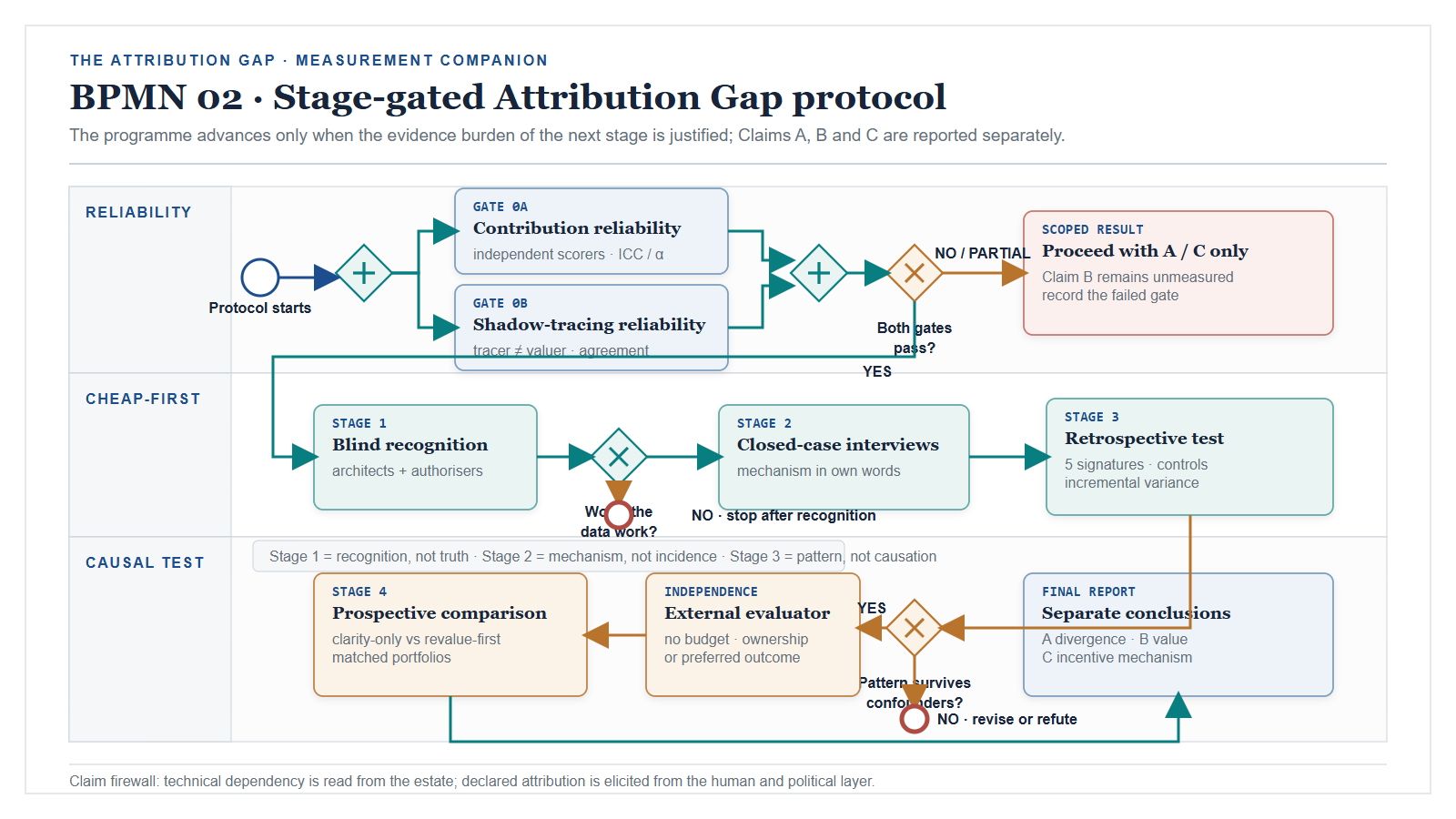
- Gate 1 – Study-0 (contribution reliability), for Claim B. Before any contribution number is used, two or more assessors score the same capabilities from the same evidence and must reach acceptable agreement (§4). Below threshold, contribution is not yet a measurement and only Claims A and C proceed.
- Gate 2 – the dependency-tracing reliability gate, for the shadow set. For the visible estate, dependency is machine-read and clean. For the shadow set that carries the discovery-gap prediction, dependency is reconstructed by tracing – effortful, partial, survivorship-prone. So for shadow capabilities, “independent machine-read dependency” is in fact a reconstruction, and if the same analyst both traces dependency and estimates contribution, the two-source independence does not protect against dependency-contribution coupling. Two safeguards, symmetric to Study-0: (i) role separation – the analyst who traces dependency for a shadow capability is not the one who estimates its contribution; (ii) a tracing reliability gate – independent analysts reconstruct the dependency of the same shadow capabilities from the same evidence and must reach acceptable agreement before those reconstructions are used.
4. The contribution estimator and its scoring protocol (Claim B)
Contribution is estimated from consequence-variables, each anchored in the technical estate or in operational record, and each independent of attribution (never drawn from budget, headcount, or recognized credit): process criticality; unique transformations performed; substitution availability; replacement cost and time; failure consequence (revenue, service, safety, compliance); tacit-knowledge concentration.
To make this a measurement rather than an opinion, the protocol fixes:
- Scales – each variable scored on an anchored ordinal scale (e.g., 0-4), with a written rubric per level.
- Evidence requirement – each score carries a scoring note citing its lineage/log/operational source; an unevidenced variable is recorded as missing, not zero.
- Aggregation – unweighted sum or mean first, to avoid premature weighting; report sensitivity to alternative weights.
- Reliability statistic – ICC for the continuous aggregate, or Krippendorff’s a for the ordinal items.
- Threshold – pre-declared (e.g., a ≥ 0.67 tentative, ≥ 0.80 strong). Below it, Claim B does not proceed.
5. The observable signatures
Five independently sourced measurements of the same gap, at different points in the lifecycle. Each notes which claim it serves.
- Signature 1 – the lists (divergence over time). (Claim A.) Technical-dependency centrality (lineage) versus declared attribution (importance rating, budget), at two or more time points. Expected: the most dependency-central capabilities are attributed less and less, appearing centrally early, then marginally, then absent while remaining load-bearing. The cross-sectional form is the can’t-kill-but-unlisted contradiction (absent from the asserted list, yet stakeholders refuse decommissioning: “it is the source of X”). The longitudinal widening is the strongest and hardest line (needs the measurement at two times). Confounders: age, scope, benign undocumentation, inventory reorganization.
- Signature 2 – the RACIs (responsibility claimed vs. accountability accepted). (Claim A; supports C.) For the depended-on-but-under-attributed set, the gap between how many parties claim responsibility and how many accept accountability. Construction: let pk be the proportion of respondents (or of accountability statements in the record) naming candidate owner k; report H = -Σk pk log pk when the distribution is available. A simpler first-pass measure, used before the full distribution exists, is E = (responsibility claimants) + (accepted accountable owners + ε) – high when many claim responsibility and few accept accountability. Expected: the most important capabilities are widely claimed-as-responsible and widely refused-as-accountable – the attribution gap seen in the ownership ledger. Confounders: legitimately shared ownership; matrixed structures.
- Signature 3 – the decisions (the business-case investment gap). (Claim A; outcomes.) At a rationalization or modernization decision, the budget/ownership/accountability committed in the signed business case versus the structural dependency. Expected: the wider the gap, the less investment is committed despite a structural dependency – diamonds cut or left to decay, zombies kept alive. The build-vs-buy and internalization wedges and the (probabilistic) ownership-silence outcome live here. Confounders: real redundancy; genuine end-of-life; strategic exit; in acquisitions, the capability-attributable portion only (exclude goodwill, synergy, control premium, growth options).
- Signature 4 – raised-and-ignored (“we said it fifty times”). (Claim C – the primary discriminator.) The count of times a dependency was explicitly surfaced in emails, minutes, documentation, escalations, calls versus the count of times it was subsequently not acted on, over a defined window. Expected: critical dependencies are surfaced repeatedly and systematically not acted on. Why it discriminates: neglect predicts low surfacing (genuinely unknown); incentive predicts high surfacing with persistent non-action (known, repeatedly, and obscured or ignored anyway). You cannot attribute to “lost over time” what was raised, documented, and explained dozens of times and still dropped. This is the cleanest single test of C. Confounders: legitimate deprioritization for resource reasons (control by holding budget rank constant); record availability.
- Signature 5 – accountability-avoidance (volunteering, budget and credit held constant). (Supports C and the silence outcome.) Holding budget and credit constant, the rate of volunteering for / attendance at ownership of a high-dependency task (e.g., mission-critical in production, fifty downstream dependents, high blame-exposure) versus a low-dependency task (e.g., a greenfield pilot, no dependents, high potential credit). Expected: fewer take the high-dependency task despite equal budget and credit. Why the design is clean: holding budget and credit constant isolates accountability-avoidance from mere underfunding, and turns the ownership-silence scene into a rate measurable across many meetings rather than a single anecdote. Confounders: skill/fit differences (control by task-class matching); seniority.
6. Outcome definitions and time windows
The destructive outcomes are coded separately, at the application-capability-pair level, within pre-declared windows (12/24/36 months after the ownership decision). Without a window, almost any eventual event could be read as confirming the theory.
- Non-investment – requested investment denied or absent within the window.
- Shadowing – continues operating without recognized budget, named ownership, or roadmap status.
- Elimination – formally removed or replaced.
- Scar formation – fragmentation or bridging introduced after an attempted cut (the “one became five”).
7. The decay-by-neglect rival, and the incremental-variance test (Claim C)
The chief rival to “decay by incentive” is “decay by neglect”: the divergence is just stale documentation, not actively maintained. This is Claim C’s null hypothesis, and it must be measured directly, not waved away. Neglect variables: documentation age; architecture-team capacity; update frequency; staff turnover; technical debt; CMDB/inventory quality; recent M&A; reorganization.
The test: whether attribution distortion and the responsibility-accountability asymmetry explain additional variance in the divergence and in the destructive outcomes beyond the neglect variables. If they do not, the discovery gap is stale documentation and Claim C fails. Signature 4 is the sharpest single discriminator, because high surfacing with persistent non-action is exactly what neglect cannot produce.
8. Data sources and provenance
All already exist; the constraint is willingness to share, not absence. Technical dependency – logs, lineage tooling, CMDB/integration maps, architecture models. Declared attribution – historical inventories, criticality surveys, budget/headcount records (often multi-year). Responsibility vs. accountability – RACIs and ownership registers. Decisions – business cases, investment-committee minutes, rationalization roadmaps, postmortems. Surfacings – email and meeting records, escalation logs. The retrospective stages are feasible because the same underlying quantities were recorded at the time, for other reasons.
9. The staged ladder
Cheap-first; the epistemic ceiling of each stage is stated.
- Stage 0 – the gates. Study-0 (contribution reliability, §4) and the dependency-tracing reliability gate with role separation (§3). Establishes: that contribution and shadow-dependency are measurements. Cannot establish: anything about the gap.
- Stage 1 – blind recognition survey, two arms. A short anonymous instrument asking whether the pattern is recognized. Arm 1: enterprise architects (the author can reach hundreds). Arm 2: decision-makers – CIOs, finance, portfolio owners – the people who actually authorize the cuts. The second arm matters because architects hold a professional identity around “the org kills good systems and nobody owns them,” so architect recognition partly measures a shared worldview, and the theory even casts the architect as the function the mechanism defeats; recognition by the authorizers is far stronger and partly breaks the in-group selection. Establishes: recognizability and face validity – the justification for the data work. Cannot establish: truth (shared experience can be shared folklore).
- Stage 2 – management postmortem interviews. Qualitative interviews with decision-makers on closed cases: was the capability affirmed important; who would own it; why was it cut. Establishes: the mechanism in their own words (“no one would be accountable”). Cannot establish: incidence or magnitude; subject to hindsight.
- Stage 3 – retrospective quantitative. Signatures 1-5 on historical records across firms or periods, with the neglect controls and incremental-variance test (§7) and the confounders of §10. Establishes: that A and C (and, if Stage 0 passed, B) are present, patterned, and associated with shadowing and elimination. Cannot establish: causation against an unobserved common driver.
- Stage 4 – prospective, including the strongest-identification comparison. Carry the metrics forward; and compare clarity-only versus revaluation-then-clarity on matched portfolios. This matched-portfolio prospective comparison offers the strongest identification in this ladder but remains ethically and practically constrained – an organization may refuse to knowingly expose a portfolio to a treatment the theory predicts is destructive. Realistic alternatives: stepped-wedge rollout; matched portfolios entering treatment at different times; natural experiment across business units; difference-in-differences; interrupted time series; regression discontinuity where a governance threshold determines which capabilities receive revaluation. Two requirements:
- The revaluation treatment must use the same Study-0-gated estimator (§4). [F-10] sidesteps using contribution to measure the gap, but it operationalizes contribution as the treatment; if the revaluation method is ungated, the prospective test inherits an ungated input.
- The evaluator must be external to the local incentive equilibrium, operationalized as: owns no competing application; receives no budget from the rationalization outcome; does not report to a claimant organization; has no performance objective tied to the preferred solution; uses pre-declared valuation criteria; cannot personally capture the released budget.
10. Threats to validity
- Circularity (dependency vs attribution) – handled by the two-source design (§3); contribution-side evidence never drawn from attribution-side signals.
- Dependency-contribution coupling and survivorship (shadow set) – handled by role separation and the tracing reliability gate (§3); residual survivorship (lost shadow capabilities under-recorded) is partly remedied by tracing from the visible.
- Folklore and in-group selection (survey) – Stage 1 measures recognition, not truth, and the decision-maker arm discounts architect-only sympathy.
- The obsolescence disguise (a falsifiability tension, stated openly) – the theory predicts entropy-driven cuts are recorded as “retiring legacy,” i.e., the records mislabel them as obsolescence; yet the performance-vs-informational test must separate the two using those same records. The escape is that the responsibility-accountability / ownership-silence signal (Signatures 2 and 4) is orthogonal to the obsolescence disguise and should survive it. So that test rests, by design, on the orthogonal signal rather than on the cut’s stated reason.
- Selection – firms that share historical data may differ systematically; report selection and compare sharers and non-sharers on observables.
- Hindsight – Stage 2 reconstructions are corroborative only.
- Lineage ≠ value – constrains Claim B only; handled by §4. Claims A and C are unaffected.
- The counterfactual – capabilities never built cannot be measured directly; anchored only on the rejected-build-then-buy proxy.
11. Which stage tests which claim
- Claim A – Signatures 1-3, Stage 3 (longitudinal Signature 1 = [F-2], the most exposed line).
- Claim B – Stage 0 gate + the value component of Signature 1 and the discovery-gap enrichment ([F-5]).
- Claim C – Signature 4 (primary), Signature 5, and the incremental-variance test over neglect variables (§7), plus the stewardship contrast class.
- Ownership-silence ([F-4]) – Stage 2 (qualitative) and Signatures 2, 5 (quantitative).
- Discovery gap / scars ([F-5], [F-8]) – Stage 3, with Gate 2 for the shadow set.
- Internalization / build-vs-buy ([F-6], [F-7]) – Stage 3, Signature 3, capability-attributable portion only.
- Loss is informational, not performance ([F-9]) – Stage 3 via §7 controls; discrimination rests on Signatures 2 and 4 (§10).
- The governance experiment ([F-10]) – Stage 4.
12. Discipline
The firewall holds: this protocol tests the firm-level theory on its own terms and connects to no monetary or early-warning work; any eventual convergence is a separate study whose evidential value depends on this independence. Witness is motivation; measurement is proof – the author’s practice supplies face validity (Stage 1); Stages 3-4 are what survive a skeptic. Lead with the cheap and the clean: Claim A on independent sources, established as low on the ladder as possible, before any value claim or expensive access. Firm and individual identities are protected; only aggregate, anonymized results are published; access to historical records is each organization’s to grant.
Appendix – Blind recognition survey (instrument sketch, two arms)
Short, anonymous; each item on a frequency scale (never / rarely / sometimes / often / almost always) with an optional free-text example. The architect arm and the decision-maker arm share most items, reworded for the respondent’s vantage.
- You have found applications not on a portfolio’s list of important systems that stakeholders refused to let you decommission because something critical depended on them.
- Over repeated assessments, genuinely load-bearing source systems were rated less important over time, even as dependence on them held or grew.
- In a rationalization decision, everyone affirmed a capability mattered, but when asked who would own and be accountable for it, the answer was effectively silence.
- A capability everyone depended on was widely claimed as a responsibility but refused as an accountability.
- An internal build was rejected on a fully-loaded business case, and a comparable capability was later acquired externally.
- Cutting one application produced several loosely-coupled legacy fragments plus an unused replacement (“one became five”).
- A critical dependency was raised, documented, and explained repeatedly before being ignored. (How many times, in your sharpest example: 1/2-3/4-9/10+/dozens?) – the raised-and-ignored item, the discriminator for incentive-over-neglect.
- At equal budget and recognition, you have seen people decline ownership of a mission-critical, high-dependency capability while volunteering for a low-dependency, high-visibility one. – the accountability-avoidance item.
A high “often / almost always” rate establishes that the pattern is recognized and worth the retrospective study; it does not, by itself, establish that the pattern is true. Agreement from the decision-maker arm – the people who authorize the cuts – counts for far more than agreement from architects alone.
End of measurement companion (v2). To instantiate the retrospective stages on specific portfolios, the consequence-variable rubric (§4), the neglect-variable list (§7), and the outcome windows (§6) are fixed first, both reliability gates are cleared (§3), and only then are historical records drawn – anonymized, with the owning organization’s consent.
Conceptual neighbours and references
- Nearby work. Cronbach and Meehl’s classic account of construct validity requires evidence across a nomological network; the Process Mining Manifesto grounds organisational claims in observed event traces.
- Useful connection. Both support measurement that does not define the hidden contribution solely through the disputed attribution it is meant to test.
- Most distinctive contribution here. Contribution is estimated from lineage, criticality and consequence signals kept independent of budget, ownership and recognition; an inter-rater gate and the revaluation-then-clarity comparison reduce circularity before any gap number is published.
Engineering standards connection
- ISO/IEC/IEEE 15939:2017 — provides the measurement-process discipline supporting pre-declared information needs, measures, analysis and validity checks.
- ISO 31000:2018 — provides the contextual risk frame for pre-declared criteria, confounders, treatment choices and monitoring across the staged protocol.