
This is a field notes paper: a structured conceptual contribution grounded in direct practitioner observation, prior to the formal development of a working paper. It is the opening article of a technical series examining how modern enterprise AI systems are architected for integrity — and what happens to that architecture under real operational pressure.
Modern enterprise AI systems share a common pattern: a statistical core wrapped in a deterministic envelope of guardrails, rules, and compliance checks. This series traces what happens when that envelope is tested — when the operational environment shifts, when the architecture becomes a liability rather than a safeguard, and when the system crosses from manageable complexity into emergent failure. The series is produced by the AI Integrity Management working group at The Integral Management Society — a Swiss non-profit association bringing together senior specialists from adaptive systems, complex systems, artificial intelligence, mission-critical operations and governance. The operational and research arm of the working group is Tegrity.AI.
Written for enterprise architects, MLOps leads, AI governance practitioners, and risk specialists operating in regulated and mission-critical sectors.
Summary
The integration of artificial intelligence based on statistical and foundational models into mission-critical systems is giving rise to the emergence of a new architectural “integrity” layer, whose purpose is to impose constraints, guarantee explainability, and maintain traceability under increasingly strict regulatory and safety requirements. This layer adopts patterns very close to those of classical expert systems: explicit knowledge, deterministic inference, auditable rules, and structured explanation capability. This article analyzes the regulatory and technical trends that push toward constrained and explainable architectures, reviews the notion of expert systems, and argues that modern AI guardrails in mission-critical environments are, in essence, expert systems that wrap and condition probabilistic models.
1. Regulatory and engineering trends toward constrained and explainable AI
1.1. Regulation of high-risk systems
The European AI Act establishes strict obligations for high-risk systems, including risk assessment, traceability through logging, detailed technical documentation, appropriate human oversight, and high levels of robustness and cybersecurity. In addition, it introduces transparency as a central regulatory principle, defined as the combination of traceability and explainability, and imposes specific transparency and documentation requirements for high-risk systems and general-purpose models. Technical bodies such as VDE emphasize that providers must design high-risk systems in such a way that their functioning is sufficiently transparent for deployers to interpret outputs and use them properly, directly linking the notion of transparency to that of explainability.
1.2. Explainable AI in safety and mission-critical domains
Recent literature on artificial intelligence for critical systems identifies validity, explainability, safety, and accountability as prerequisites for the qualification and certification of AI-based systems in domains such as defense, transport, or air traffic control. In public safety networks and emergency management, XAI frameworks have been proposed that integrate techniques such as SHAP and LIME to make both global and local decisions traceable, improving the trust of operators and policy-makers. Studies on explainability requirements in safety-critical systems show that explainability must be treated as a systems engineering requirement, with specific criteria regarding addressees, granularity, verifiability, and suitability to the operational context.
1.3. Determinism, reliability, and the tension with stochastic models
Mission-critical systems are traditionally characterized by requiring behaviour that is highly reliable and as deterministic as possible, so that the relationships between variables are known and outcomes and failure modes can be predicted. Deep learning models and foundation models introduce stochastic behavior and opacity, which comes into tension with these requirements for determinism and predictability. This tension is managed through the introduction of control, validation, and supervision layers that constrain the model’s behavioral space, favoring architectures in which the probabilistic component operates under an environment of explicit and verifiable rules.
2. AI guardrails as an integrity layer
2.1. Definition and functions of guardrails
Recent industrial and academic literature uses the term “AI guardrails” to refer to the technical, organizational, and governance mechanisms that constrain the behavior of foundation models and other AI systems to acceptable parameters of safety, compliance, and policy alignment. Technical guardrails are typically implemented at three levels: data layer (input filtering and sanitization), model layer (validation of model behavior), and output layer (filtering and correction of responses, detection of hallucinations or policy violations). Large-scale platform architectures describe centralized guardrail patterns that perform runtime inspection, input validation, validation of intermediate reasoning steps, and static analysis of generated code, with sub-second latencies so that they can be used in production.
2.2. Taxonomies and multi-layering
Recent taxonomies of guardrails in systems based on foundation models distinguish between model development guardrails, runtime guardrails, and application guardrails, and classify their underlying techniques into rule-based, hybrid, and machine-learning-based models. Architectures inspired by the “Swiss cheese model” of safety have been proposed, where multiple layers of guardrails are combined to provide defense in depth, accepting that any individual layer may partially fail. In regulated environments, it is emphasized that many guardrails are deterministic and based on explicit rules precisely in order to allow auditability and demonstration of compliance.
2.3. Determinism, rules, and auditability
The notion of “deterministic AI” has been proposed to describe decision systems that follow explicit rules and logic in such a way that the same inputs always produce the same outputs, with completely auditable decision paths. In this approach, guardrails materialize in a rules engine, a knowledge graph, and an inference engine that apply constraints, limits, permissions, and mandatory checks, and that record which rules are triggered, which data are used, and which decision paths are followed. Work on graph-based deterministic inference proposes using domain models built from first principles, in the form of knowledge graphs with causal relationships and explicit rules, to verify or guide the outputs of foundation models, thus combining the advantages of classical expert systems with the flexibility of LLMs.
3. Expert systems: definition and architectural characteristics
3.1. Fundamental components
Expert systems were one of the earliest forms of symbolic AI applied to complex decision, diagnosis, and recommendation problems in specific domains such as medicine, finance, or engineering. Their typical architecture includes at least a knowledge base with facts and rules, an inference engine that applies rules to facts, a user interface, and frequently an explanation module that justifies conclusions. The knowledge base stores declarative and procedural knowledge elicited from expert humans, while the inference engine executes reasoning mechanisms such as forward chaining or backward chaining to derive conclusions in a systematic and reproducible way.
3.2. Deterministic reasoning and traceability
A central characteristic of expert systems is their essentially deterministic reasoning: given the same premises and the same set of rules, the system produces the same conclusions, unless rules with uncertainty or certainty factors are explicitly used. This makes it possible to trace precisely which rules and facts have contributed to a given conclusion, facilitating audit and validation by human experts. In many designs, the explanation module can generate chains such as “because conditions A, B, and C were met, rule R was applied and therefore X is concluded,” which constitutes an early form of explainability integrated into the architecture.
3.3. Historical application in critical systems
Expert systems were historically used in environments where traceability and validation by experts were critical, such as clinical decision support, fault diagnosis in industrial systems, or financial advisory systems. In these domains, the possibility of explicitly capturing expert knowledge, imposing business rules, and reviewing the system’s reasoning made them suitable for regulated or sensitive environments, provided that the limitations of knowledge coverage and maintenance of the rule base were controlled.
4. Convergence: modern guardrails as expert systems
4.1. Structural parallelism
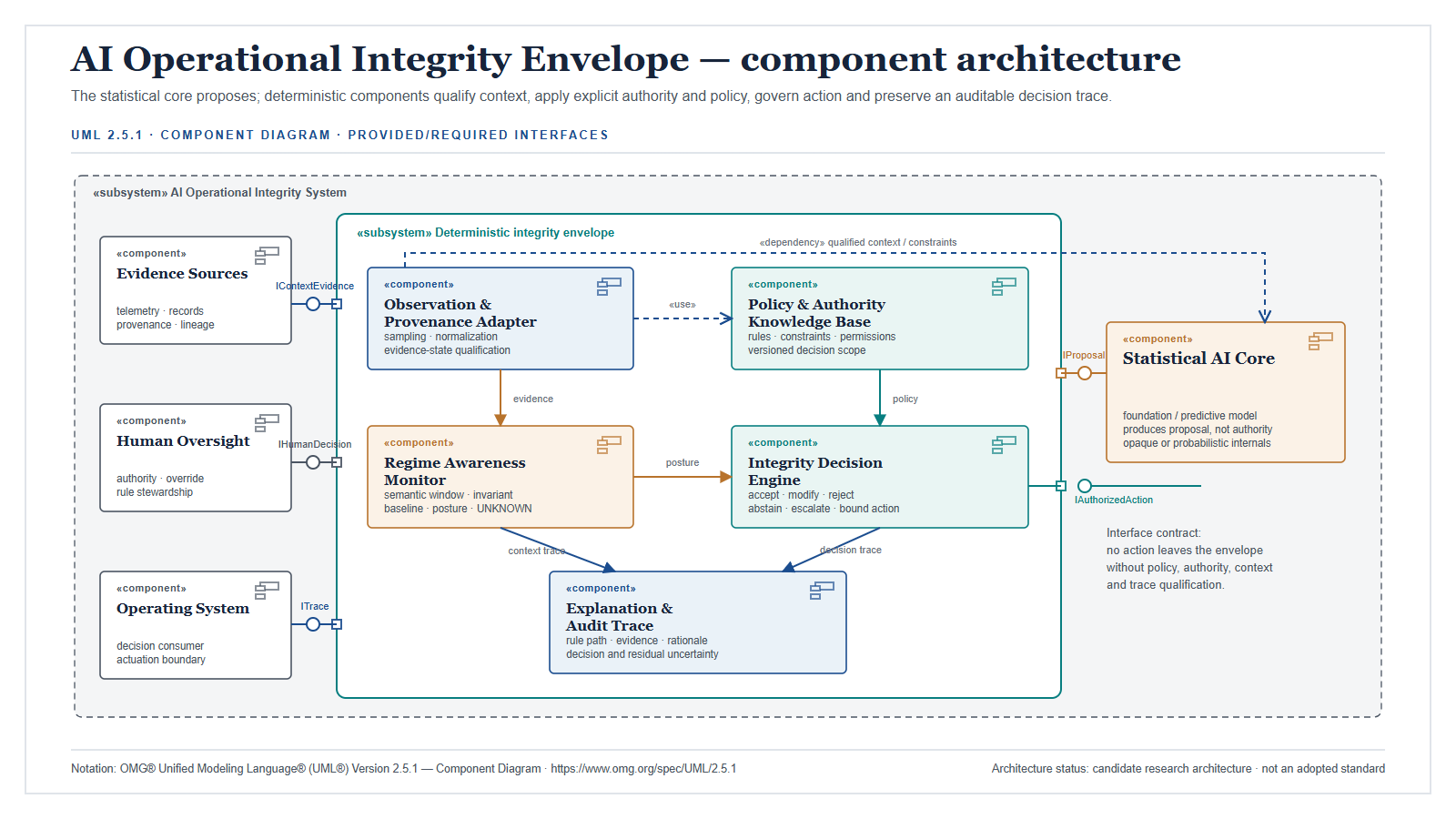
If deterministic guardrail architectures for generative AI are compared with those of classical expert systems, clear parallels appear. Both are based on an explicit representation of domain knowledge (rules, knowledge graphs, policies, limits), on an inference or rules engine that applies that representation to concrete facts, and on mechanisms for logging and explanation of reasoning. In the case of guardrails for foundation models, the “fact” is typically a proposed action or response generated by the probabilistic model, which is accepted, modified, or rejected according to deterministic rules encoded in the integrity layer.
4.2. Expert systems as wrappers around probabilistic models
Recent work explicitly shows architectures in which a deterministic inference engine, based on knowledge graphs or rules, acts as the primary decision-maker, while the foundation model is used as a linguistic interface or generator of hypotheses. In this “graph-first reasoning” pattern, the deterministic system guarantees regulatory compliance, consistency, and explainability, and the probabilistic model contributes flexibility in natural language interpretation and in the generation of user-friendly descriptions. In an analogous way, some anomaly detection systems combine change-point detection algorithms with expert systems to classify states and behaviors in domains such as fuel pressure analysis, taking advantage of expert systems’ ability to formalize the classification criteria of human engineers.
Executable contract · abstention before unauthorized action
from tegrity_reference.regime_governor import (
    ContextStatus, DecisionContract, Disposition, govern,
)

result = govern(DecisionContract(
    ContextStatus.QUALIFIED,
    deviation_detected=True,
    authority_present=False,
    pointwise_non_inferior=True,
))
assert result.disposition == Disposition.HOLD4.3. Multi-model and separation of concerns
The convergence toward hybrid architectures translates into a clear separation of concerns: machine learning models optimize predictive accuracy and generalization capability, while the expert-system-like layer defines the space of allowed decisions, alarm conditions, escalation criteria to human intervention, and associated explanations. This separation is consistent with recommendations from AI risk management frameworks and with regulatory requirements that demand both technical control and meaningful human oversight in high-risk systems.
5. Regime change detection as a core integrity capability
5.1. Concept and relevance in mission-critical environments
Regime change detection, or change-point detection, refers to the identification of points in time at which the statistical properties of a process change significantly. In industrial and safety-critical systems, methods for detecting change points in non-uniform data streams are essential for detecting degradation, emerging failure modes, or changes in operational context that may affect the validity of deployed AI models. Recent reviews emphasize that algorithm selection, data quality, and real-time requirements are decisive for the effectiveness of these methods in practical applications.
5.2. Supervised, unsupervised, and hybrid methods
Supervised, unsupervised, and hybrid approaches have been developed for regime change detection, with different trade-offs between accuracy, flexibility, and computational cost. Supervised methods can achieve very high accuracy levels in well-characterized environments with labeled data, such as quality control in manufacturing, while unsupervised methods are more suitable for dynamic environments with unanticipated changes. Advanced methods based on Dynamic Mode Decomposition with control allow the behavior of nonlinear systems subject to aging and control effects to be tracked, providing interpretable change scores in time and frequency domains.
5.3. Integration with expert integrity systems
Industrial examples show how change-point detection algorithms such as PELT can be combined with expert systems to provide consistent and reproducible solutions in the classification of states and behaviors of complex signals, reducing the variability among human engineers’ judgments. In an integrity architecture, the output of regime change detectors can feed an expert system that encodes domain knowledge on which changes are acceptable, which indicate failure conditions or reduced safety, and which actions should be triggered, from model readjustment to escalation to human operators. In this way, regime change detection is not left “free” but rather integrated into a deterministic decision layer that acts as a guardrail over anomaly analytics itself.
6. Architectural implications for mission-critical instances
6.1. Integrity layer as expert system
The examined evidence suggests that, in mission-critical environments, regulatory and engineering trends push toward architectures in which the integrity layer surrounding AI models structurally resembles an expert system: explicit knowledge, deterministic inference engine, auditable rules, and explanation capabilities. This layer acts as an input, output, and context guardrail over probabilistic models, including foundation models, ensuring that their effective behavior remains within defined and traceable limits.
6.2. Pre-hoc and post-hoc explainability
Architecturally, explainability can be materialized both pre-hoc, through the deterministic design of the integrity layer itself and its explanation module, and post-hoc, through XAI techniques applied to the underlying models. In high-risk systems, regulation and industrial practice tend to require both: models that are as transparent as possible combined with external mechanisms of explanation, documentation, and traceability operating at the system level. In practice, this reinforces the role of the expert-system-like layer as an explainability anchor point, from which explanations can be articulated by integrating business rules, sensor states, anomaly diagnostics, and justifications based on XAI models.
6.3. Need for hybrid approaches and limitations
Although the described trends are clear, it would be too strong to claim that all AI architectures converge on this form: low-risk domains may tolerate more opaque or less constrained models. However, in the specific space of mission-critical and high-risk applications, the combination of regulatory requirements, accountability expectations, and the need for reliability makes hybrid architectures with expert-system-like integrity layers increasingly the norm. Significant challenges remain regarding engineering cost, maintenance of knowledge bases, coverage of edge cases, and alignment between deterministic rules and statistical models, and these constitute active lines of research and development.
7. Conclusion
Recent developments in regulation, XAI, guardrails, and regime change detection point to an architectural convergence in which AI systems for mission-critical environments are structured as combinations of probabilistic models encapsulated within deterministic integrity layers with the nature of expert systems. These layers define explicit rules, manage the detection of and response to regime changes, provide explanations, and guarantee traceability, acting as guardrails over the generative and predictive capabilities of AI. From a systems engineering perspective, the reuse of principles from classical expert systems in the design of these layers offers a solid framework for meeting the demands of safety, compliance, and accountability in mission-critical environments, although it raises substantial scalability and maintenance challenges that require rigorous methodological approaches and adequate support tools.
8. The Tegrity.AI path

What is now called Tegrity.AI emerged from more than twenty years of work across different generations of intelligence systems. The trajectory started with classical business intelligence, operational dashboards and early-warning indicators; evolved into expert systems and deterministic rule engines for mission-critical environments; later incorporated machine learning, deep learning and anomaly detection; and today extends into agentic AI architectures with supervisory guardrails and regime change detection. In that sense, the current convergence toward neuro-symbolic, explainable and constrained AI is not entirely new. It is, rather, the re-emergence of a long-standing engineering principle.
In high-stakes environments, intelligence is only valuable when it remains reliable, explainable and operationally governed.
Conceptual neighbours and references
- Nearby work. Neuro-symbolic AI combines statistical learning and symbolic reasoning (Hitzler and colleagues), while shielding interposes a formally constrained layer at runtime.
- Useful connection. Both traditions support hybrid systems in which predictive performance and rule-governed safety are different architectural responsibilities.
- Most distinctive contribution here. The envelope is not only a veto: Regime Awareness enters its reconfiguration path so the admissible corridor itself can change when its historical context becomes invalid, without pretending to forecast the future.
Engineering standards connection
- ISO/IEC 23053:2022 — provides a common functional framework for describing ML-based AI systems and their interactions.
- ISO/IEC/IEEE 42010:2022 — supplies the architecture-description discipline needed to distinguish the system, its views and the concerns addressed by the deterministic envelope.