Document Status — Field Notes · Series: Human Intelligence Debt, Paper 2
This document is a field notes paper: a structured conceptual contribution grounded in direct practitioner observation, prior to formal empirical validation. It extends the framework introduced in Human Intelligence Debt: A Socio-Technical Metric for Measuring the Human Cost of Imperfect Data Flows. Readers unfamiliar with the core definitions — Human Intelligence Contribution Ratio (HICR), Human Intelligence Contribution Target (HICT), and Human Intelligence Debt (HID) — are encouraged to read that paper first. The next stage of this series will be a working paper developing the measurement methodology and a preregistered empirical research protocol; empirical results will follow instrument validation.
Two Notes on Capability Fragmentation and the Architecture of Human Intelligence Waste
Prefatory Note
The framework introduced in Human Intelligence Debt defines the Human Intelligence Contribution Ratio (HICR) as the actual proportion of operators performing roles that add information that cannot be obtained by non-human means, and the Human Intelligence Contribution Target (HICT) as the ideal proportion under a perfectly architected socio-technical environment. Human Intelligence Debt is the gap between them.
The core claim of that paper is that technological progress tends to increase HICT — raising the theoretical ceiling of what architecture could deliver — while organisations consistently fail to convert that potential into a higher HICR. Instead, they accumulate new layers of fragmentation, governance overhead, validation work and human middleware performing mechanisable roles.
The two notes that follow press on a specific question that the original framework left implicit: what is the structural mechanism by which this accumulation occurs? The first note introduces an analogy from physical production that makes the mechanism visible. The second develops the consequences of that mechanism through the lens of data governance and AI amplification.
Note 1 — The Harvester Multiplication Problem
Does the accumulation of Human Intelligence Debt follow a pattern that we would immediately recognise as absurd in any physical production process, but that we consistently fail to see in informational ones?
Consider a wheat field as a model of an organisational information flow. The wheat — the total volume of data that must be harvested, processed and converted into usable output — is fixed by the operational reality of the organisation. The harvesting machine is the available technology of the period.
In the pre-digital baseline, suppose we have 1,000 workers and zero harvesters. The work is entirely manual. It is slow, but it is coherent: every worker is directly engaged with the wheat.
Now a harvesting machine arrives. One machine, operated by 10 workers, can cover the entire field. Under the Ideal Operational Intelligence State described in the first paper of this series, this is precisely what happens: technology absorbs the manual work, and the remaining human effort concentrates on activities the machine cannot perform — judgment, exception handling, genuine decision-making. The Human Intelligence Contribution Ratio rises. The workforce may contract to 400, but those 400 are genuinely needed.
But what if, instead, the organisation ends up with 10 harvesters and 400 workers?
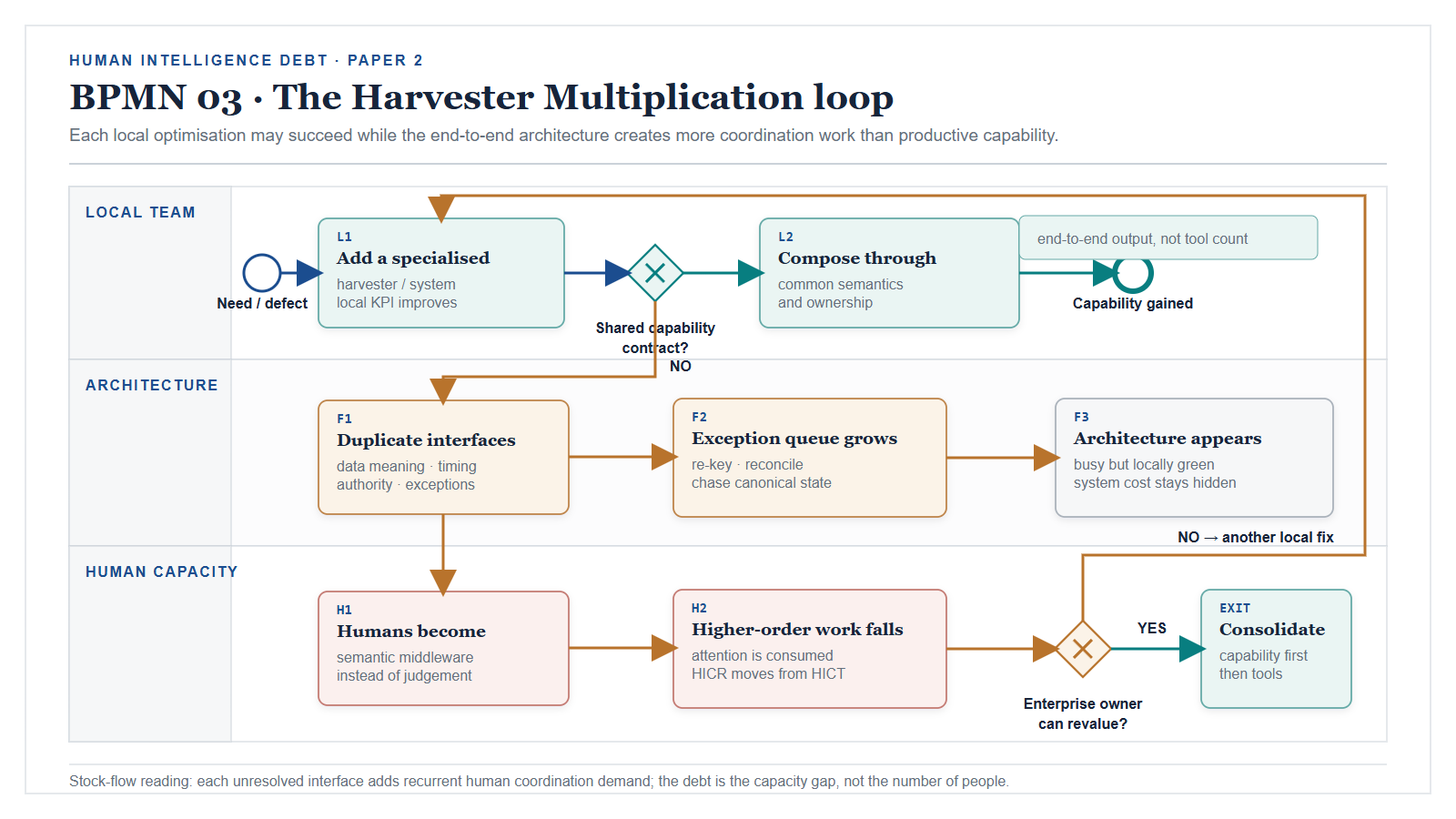
On the surface, this looks like progress: 400 is fewer than 1,000. But look at what actually happened. Each harvester operates on a different axis — one harvests horizontally, another vertically, a third diagonally. Each produces output in a different format. None of their outputs are directly compatible. A significant portion of the 400 workers are not harvesting wheat at all. They are moving sheaves from one harvester’s output bin to another’s input. They are reconciling overlapping coverage zones. They are managing the coordination between machines that were never designed to work together.
One coherent harvester with 10 workers outperforms 10 fragmented harvesters with 400.
The critical ratio here is not workers per field. It is workers per harvester. If a single well-integrated harvester requires 10 workers to operate at full capacity, and we have deployed 10 harvesters that collectively require 400 workers, then we have not achieved a 100x improvement in harvesting capacity. We have achieved a 4x increase in coordination overhead per unit of harvesting power — while the wheat field itself has not grown.
This is the precise structural condition that the Human Intelligence Debt Accumulation Hypothesis describes. The question is whether current enterprise architectures — and emerging AI deployments in particular — are moving organisations toward one coherent harvester or toward a field full of incompatible machines that require more human coordination than the manual process they replaced.
The wheat does not care how many harvesters are in the field. It only cares whether it gets harvested.
A note on the manufacturing equivalent
The same pattern is immediately legible — and immediately rejected as absurd — when applied to physical manufacturing. Imagine an automobile assembly line in which the steering wheel is installed six times. The first worker fits it. The second removes and refits it to a slightly different specification. The third torques it to a standard that conflicts with the fourth worker’s process. The fifth verifies that the first four were consistent. The sixth signs off on compliance documentation confirming the steering wheel is present.
No operations manager would accept this. The waste is visible, countable and embarrassing.
Yet in informational flows, the equivalent process is commonplace and largely invisible. The same customer record is entered in the CRM, re-entered in the ERP, re-validated in the billing system, reconciled monthly by an analyst, summarised in a report, and re-entered manually into a regulatory submission — six touches of the same data element, each one generating its own governance overhead, its own error surface, and its own human coordination cost.
The data does not become more accurate with each re-entry. It becomes less so. And the cost is paid not in steel and assembly time, but in human cognitive capacity that the Human Intelligence Debt framework correctly identifies as structurally absorbed rather than genuinely deployed.
The framework’s central contribution may be precisely this: making the invisible assembly line visible.
Note 2 — From Harvester Multiplication to Governance Collapse
The Real Cost of Capability Fragmentation
The harvester analogy introduced in Note 1 points toward a more precise question: when an organisation deploys multiple systems to cover a single business capability, what exactly do the additional workers do?
The answer is not primarily that each harvester requires its own operator. The answer is that the interaction between incompatible harvesters generates an entirely new category of work that did not exist before — work that has no equivalent value in the field, produces no wheat, and would disappear entirely if the architecture were coherent.
This interaction cost is the true driver of Human Intelligence Debt accumulation. And it manifests in a cascade of data governance failures that compound each other.
Note (added for series coherence). The unit at stake is not raw application count but incoherent capability multiplicity — the number and degree of functional overlap among the systems serving one capability, weighted by the human coordination it generates. The argument is therefore not that one application per capability is always optimal: justified multiplicity exists where resilience, regulation, regional autonomy or genuinely specialised function requires it. The relevant benchmark is the minimum coherent solution set for a capability, and the debt lies in multiplicity beyond it. The forthcoming measurement working paper expresses this excess directly, as compensatory cognitive hours generated per capability.
The Governance Cascade
When the same business capability — managing a customer, recording an inventory movement, processing an order — exists across multiple systems simultaneously, the organisation immediately inherits a set of structural problems that cannot be solved by adding more technology. They can only be solved by reducing the fragmentation that caused them. The cascade unfolds in a predictable sequence.
Data ownership collapse
When the same data element exists in three systems, no one owns it. Every decision that depends on it implicitly requires a negotiation about which version is correct — invisible, informal and expensive.
Data lineage opacity
When a number appears in a report, its origin becomes untraceable across a fragmented landscape. In a coherent architecture, lineage is native. In a fragmented one, lineage is archaeology.
Loss of the single version of truth
The «correct» version of a customer’s address, credit limit or order status stops being a technical question and becomes a political one. Political questions consume human time.
PII dispersion & uncontrolled exposure
No one can answer with confidence where a person’s data currently exists. GDPR-style erasure, rectification and breach obligations all presuppose knowledge that fragmentation makes practically unattainable.
Cross-system vulnerability surfaces
Each system boundary is an attack surface; each integration point, a corruption vector. This is an architectural problem whose solution is fewer systems, not better firewalls.
Data poisoning amplification
When training data or retrieval contexts draw from inconsistent sources, the model inherits the fragmentation. Human Intelligence Debt in the data layer becomes model unreliability in the AI layer — the debt migrates upward.
The Real Workers-per-Harvester Problem
In a fragmented capability landscape, the workers associated with each harvester are not primarily operating the machine. They are managing the consequences of its incompatibility with the other machines. The actual distribution of effort looks approximately like this:
- A small proportion are doing what the system was purchased to do — entering data, generating outputs, making decisions.
- A larger proportion are reconciling that system’s outputs with other systems: checking whether the CRM customer matches the ERP customer, whether the inventory count in System A matches System B, whether the compliance report generated by one platform is consistent with the audit trail in another.
- A further proportion are managing the programme: integration backlogs, change management initiatives, data migration projects, governance committees, data quality dashboards, stewardship forums, and cross-functional alignment meetings that exist specifically because the systems do not align automatically.
- A residual proportion are performing the audit and risk function: mapping where PII is located, assessing cross-system vulnerability exposure, documenting data lineage for regulatory purposes, and maintaining the compliance posture of a landscape that generates compliance risk by its very structure.
None of these activities harvest wheat. All of them are generated by the decision — often made incrementally, without architectural oversight — to add another harvester rather than optimise the one already running.
Two Cases That Illustrate the Pattern
Case A — The feature-marginal adoption
An organisation acquires a comprehensive marketing automation platform. The stated justification is a single feature: the push notification behaviour when a visitor lands on a page. The platform’s remaining capabilities — segmentation, lead scoring, campaign orchestration, behavioural analytics — overlap substantially with two existing tools already in the stack. Rather than rationalising the landscape, the organisation tasks its technical team with integrating the data flows between all three systems. The integration request enters the development backlog and is repeatedly deprioritised against higher-urgency items. The three systems continue to maintain divergent visitor profiles. The push notification fires. The integration remains unbuilt. The governance cost of three semantically inconsistent customer identity systems accumulates silently, quarter after quarter.
Case B — The migration debt spiral
An organisation undertakes a rationalisation initiative to decommission a legacy inventory management system. During the decommissioning process, previously undocumented dependencies are discovered: historical inventory data exists only in the legacy system’s proprietary format; compliance reports are generated by a module with no equivalent in the replacement platform; a real-time integration depends on a specific API endpoint the new platform does not expose. Rather than halting and redesigning, the organisation implements tactical solutions: a bridging system, a reporting adapter, a custom integration layer. Each introduces its own data model, update schedule and governance surface. At the conclusion of the rationalisation initiative, the organisation operates five systems where it previously operated one. The original legacy system remains running. The decommissioning project is formally closed. The Human Intelligence Debt has quintupled.
The AI Amplification Risk
Both cases above required organisational decisions, procurement cycles, IT involvement and at least some degree of architectural review — however inadequate — before new systems were introduced. The threshold for capability multiplication, while low, was not zero.
In an AI-augmented environment, that threshold approaches zero.
An individual contributor frustrated with the official data reporting process can now build a functional alternative in an afternoon: a retrieval-augmented generation system grounded on a document store they control, producing outputs that look authoritative and are immediately useful. They will not file an architecture review request. They will not document the data lineage. They will not map the PII exposure. They will use the tool because it works, and share it with their team because it is helpful.
Multiply this by the size of the organisation. The result is not a harvester multiplication problem.
It is a harvester proliferation problem — where the rate of new capability introduction permanently exceeds the organisation’s capacity to govern, integrate or rationalise it.
The Human Intelligence Debt Accumulation Hypothesis may therefore be structurally conservative in its projections for the AI period. The historical pattern — in which each technology wave increased HICT faster than organisations could convert it into a higher HICR — assumed that capability introduction had some minimum friction. When that friction disappears, the gap between ideal and real may not accumulate gradually. It may compound.
The decisive architectural question is therefore not whether organisations should adopt AI, but whether they can develop the institutional capacity to govern capability multiplication at the speed AI enables.
This work is produced by the AI Integrity Management working group at The Integral Management Society, a Swiss non-profit association bringing together senior specialists from adaptive systems, complex systems, artificial intelligence, mission-critical operations and governance.
Conceptual neighbours and references
- Nearby work. Galbraith’s information-processing view explains coordination structures under uncertainty; the IIA Three Lines Model distinguishes complementary governance roles.
- Useful connection. They help separate useful functional plurality from uncontrolled multiplication of overlapping capabilities and interfaces.
- Most distinctive contribution here. The unit is incoherent capability multiplicity beyond a minimum coherent solution set, weighted by the human work generated between systems; the governance cascade traces how overlap propagates into ownership, lineage, truth, privacy and AI-reliability failures.
Engineering standards connection
- ISO/IEC/IEEE 42010:2022 — provides a disciplined way to expose stakeholder concerns, viewpoints and model fragmentation across locally optimised components.
- ISO/IEC/IEEE 15288:2023 — provides the system-life-cycle process frame for integration, operation, support and retirement across system elements.